Email this article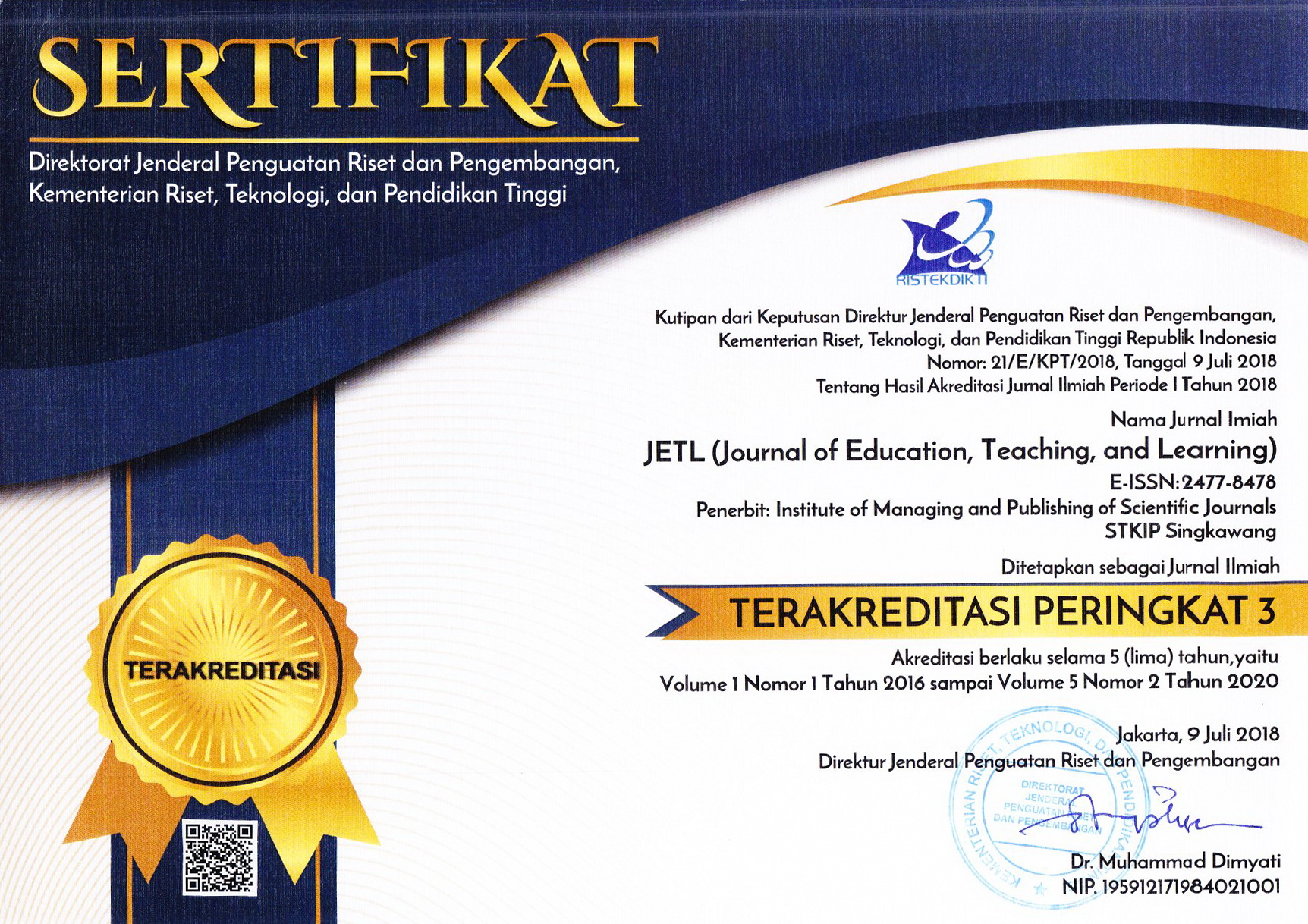


Strengthening Ethical Competence in Digital Communication Among Students in West Kalimantan
Abstract
This research fundamentally aims to understand and describe the strengthening of ethical competence in digital communication among students in West Kalimantan. Based on the background review and analysis presented, the approach and method used in this study is a quantitative approach through a survey study, by distributing questionnaires to teachers in various districts/cities in West Kalimantan. The data obtained is collected and analyzed using statistical formulas, then presented in the form of tables, diagrams, or graphs to provide ease for readers in understanding the meaning of the data presented.
The study concludes that: (1) strengthening ethical competence should be an integral part of the overall school program. Specific guidance from teachers in students' digital communication is highly needed; (2) strengthening ethical competence has several positive elements, particularly in fostering comfortable communication and a conducive learning environment that enables better interaction between students and teachers, as well as among students themselves; (3) strengthening ethical competence in digital communication for students covers several fundamental aspects, particularly regarding etiquette and the way to express gratitude in communication processes, initiating conversations, expressing ideas, or conveying information or thoughts in communication; (4) an evaluation of strengthening students' ethical competence in digital communication needs to be conducted, especially by involving all school elements, particularly teachers and school staff.
Full Text:
PDFReferences
Amalia, K. (2023). Course Review: Kemampuan Komunikasi di Era Digital. Https://Codemi.Co.Id/. https://codemi.co.id/kemampuan-komunikasi-di-era-digital/
Amin, Maswardi M. (2013). Pendidikan Karakter Anak Bangsa. Edisi Revisi. Jakarta: Baduose Media Jakarta.
Astari , A. C., dkk. (2018). Komunikasi dan Media sosial. Communication and Media.
Australian Council for Educational Research (ACER). (2022). The Impact of Early Digital Ethics Education on Student Behavior in Online Environments.
Ayi, Suherman. (2018). The Implementation Of Character Education Values In Integrated Physical Education Subject In Elementary School. Journal SHS Web of Conference. Journal Social Science. ISSN: 2261-2424 (Online).
Aziz, Samsudin. (2009). Karakter Pemuda Pilihan. Jakarta: rimbooks.
Byron, T. (2008). Safer Children in a Digital World: The Report of the Byron Review. Department for Children, Schools and Families.
Crawford, K., & Schultz, J. (2019). AI ethics: Principles, policy, and practical considerations. Data & Society.
Ess, C. (2022). Digital Media Ethics: A Comprehensive Guide. Routledge.
Flew, T. (2019). Digital communication, the crisis of trust, and the post-global. Communication research and practice, 5(1), 4-22.
Floridi, L. (2020). The ethics of artificial intelligence. Oxford University Press.
Gardner, H., & Davis, K. (2013). The App Generation: How Today’s Youth Navigate Identity, Intimacy, and Imagination in a Digital World. Yale University Press.
Gillespie, T. (2018). Custodians of the internet: Platforms, content moderation, and the hidden decisions that shape social media. Yale University Press.
Global Alliance. (2023). Digital Communication and Ethical Problems: Insights from two studies.
Han, M., Røkenes, F., & Krumsvik, R. (2021). Digital competence and ethical challenges in education. Springer.
Isrokatun I, dkk (2022). Digital Literacy Competency of Primary School Teacher Education Department Student as the Demands of 21st Century Learning. Elementary School Forum (Mimbar Sekolah Dasar), v9 n3 p466-483 2022.
Istiqomah A., Widiyanto, P. (2023). Integrasi Pendidikan Nilai Dalam Pendidikan Kewarganegaraaan Melalui Pendekatan Evokasi Berbasis Teknik Klarifikasi Nilai. Jurnal Calacakra Ilmu Pendidikan, Vol 4 No 2.
Kalidjernih, Freedy K. (2011). Puspa Ragam, Konsep dan Isu Kewarganegaraan. Bandung: Widya Asara Press; Edisi ketiga.
Kearney, M. M., & McMahon, A. F. (2020). Ethical Communication in the Digital Age: Exploring Best Practices. Journal of Media Ethics, 35(2), 73-85. DOI: 10.1080/23736992.2020.1745825.
Kementerian Pendidikan Nasional. (2011). Pendidikan Budaya dan Karakter Bangsa. Jakarta : Direktorat Pembinaan SMA.
Majid, Abdul. (2010). Peranan Pendidik dalam Upaya Membentuk Karakter Peserta Didik. Pendidikan Karakter. Jurnal Publikasi Ilmiah Vol 2, Nomor 2 Juli 2010. Issn 20860226.
Maunah B. (2018). Implementasi Pendidikan Karakter Dalam Pembentukan Kepribadian Holistik Siswa. Jurnal Pendidikan Karakter, Vol 6, No 1.
Moerdiyanto. (2012). The Picture o f Senior High School’s Culture The Challenge and Opportunity. FISE Yogyakarta State University.
Mossberger C., Tolbert CJ., McNeal RS Caroline. (2008). Digital Citizenship: The Internet, Society, and Participation, Journal of Information Technology & Politic, Volume 5, 2008-Issue 2.
Muctarom M., Anggi PYP., Rima VPH. (2018. Penguatan Etika Digital Pada Siswa Untuk Menanggulangi Penyebaran Berita Bohong (Hoax) Di Media Sosial Melalui Pendidikan Kewarganegaraa. Paedagogia Jurnal Ilmu Pendidikan, Vol 21, No 2
Mulyana, D. (2000). Ilmu Komunikasi. Jakarta: Remaja Rosdakarya.
Ng, W., Zhang, J., & Aslan, S. (2022). Teachers' AI digital competencies and twenty-first century skills in the post-pandemic world. Educational Technology Research and Development.
Opata, CN., Alfred S & Stephen T. (2017). The Cultural School of Strategic Formulation (Strategy Formulation Based on Social Interactions, Beliefs and Tradition, DOI: 10.4236/ojbm.2017.52029.PP. 335-347
Pew Research Center. (2021). Literacy in the Digital Age: Evaluating Skills for 21st-Century Citizens. Pew Research Center.
Prasetyo D dan Marzuki. (2016). Pembinaan Karakter melalui Keteladanan Guru Pendidikan Kewarganegraan di Sekolah Islam Al Azhar Yogyakarta. Jurnal Pendidikan Karakter, tahun VI, Nomor 2, April 2016. ISSN: 20189-50003.
Regan, P. M. (2016). Privacy And Technology: Exploring Government Surveillance, Big Data, And Encryption. In Social Issues In Computing. MIT Press.
Revuelta-Domínguez, F., et al. (2022). Enhancing digital competency in teacher professional development. Frontiers.
Ribble, M. (2011). Digital Citizenship in Schools: Nine Elements All Students Should Know. International Society for Technology in Education (ISTE).
Roso, Calvin G. (2013). Study of Life and Experience. Journal of Research on Cristian Education. Volume 22, 2013 – Issue: Education in the Abrahamic Faith Traditions. Published online: 15 April 2013.
Steyer, J. P. (2012). Talking Back to Facebook: The Common Sense Guide to Raising Kids in the Digital Age. Scribner.
Stumbrienė, A., Jevsikova, T., & Kontvainė, R. (2023). Adoption of digital technology in educational practice. Education and Information Technologies.
Subekti, Wisnu. (2017). “Seperti Apa Sih Teknologi Digital Itu?” Zenius.net. https://www.zenius.net/ blog/ pengertian- teknologi-digital (April 12, 2023).
Subiakto, H. (2016). Transformasi Teknologi Komunikasi Digital Terhadap Perubahan Sosial Sebagai Persoalan Aktual. Pidato Pengukuhan Guru Besar Universitas Erlangga
Tiozzo, M ., Ott, T. (2022). Digital Media Ethics: Benefits and Challenges in School Education. International Journal of Mobile and Blended Learning (IJMBL), 14(2), 1-8. doi:10.4018/IJMBL.304459.
UNESCO. (2020). Ethics and Artificial Intelligence: Towards a Global Framework for Ethical AI. UNESCO Publishing.
Wahyudi Eko. (2024). Mengenal Etika Digital dalam Aturan Teknologi. https://www.fortuneidn.com/tech/eko-wahyudi.
Werner, S. J., & Tandkard, J. W. (2011). Teori Komunikasi. Edisi 5. Prenada Media Group.
West, G., & Berg, D. (2021). Digital Communication Ethics: Building Trust in a Connected World. HarperTech Press.
West, G., & Berg, D. (2021). Trust and Ethics in Digital Communication. International Journal of Communication, 15, 345-362. Link.
Wido, Mardi. (2010). Membangun Pendidikan Karakter Bangsa Berbasis Budaya Sekolah dan Komunitas Sekolah. Prosiding Seminar, Aktualisasi Pendidikan Karakter Bangsa, 15 November 2010. Bandung: Widya Iswara Press.
Wuryandani W, Faturrohman, Unik A. (2016). Implementasi Pendidikan Karakter Kemandirian di Muhammadiyah Boarding School. Cakrawala Pendidikan. Jurnal Ilmiah Pendidikan. Juni 2016, Th XXXV, No 2. Yogyakarta: LPPMP UNY.
DOI: http://dx.doi.org/10.26737/jetl.v10i1.6286
Refbacks
- There are currently no refbacks.


This work is licensed under a Creative Commons Attribution-NonCommercial 4.0 International License.
Published by:
Institute of Managing and Publishing of Scientific Journals STKIP Singkawang
Sekolah Tinggi Keguruan dan Ilmu Pendidikan (STKIP) Singkawang
Address : STKIP Singkawang, Jalan STKIP - Kelurahan Naram Singkawang, Kalimantan Barat, INDONESIA, 79251
No. Telp. : +62562 420 0344
No. Fax. : +62562 420 0584
JETL (Journal of Education, Teaching, and Learning)
e-ISSN : 2477-8478
p-ISSN : 2477-5924

Editor in Chief Contact: [email protected] / Wa: +6285245101122
Publisher Contact: [email protected] / Wa: +6281217024040/+6285750845033
Management Tools



JETL Indexed by: