Email this article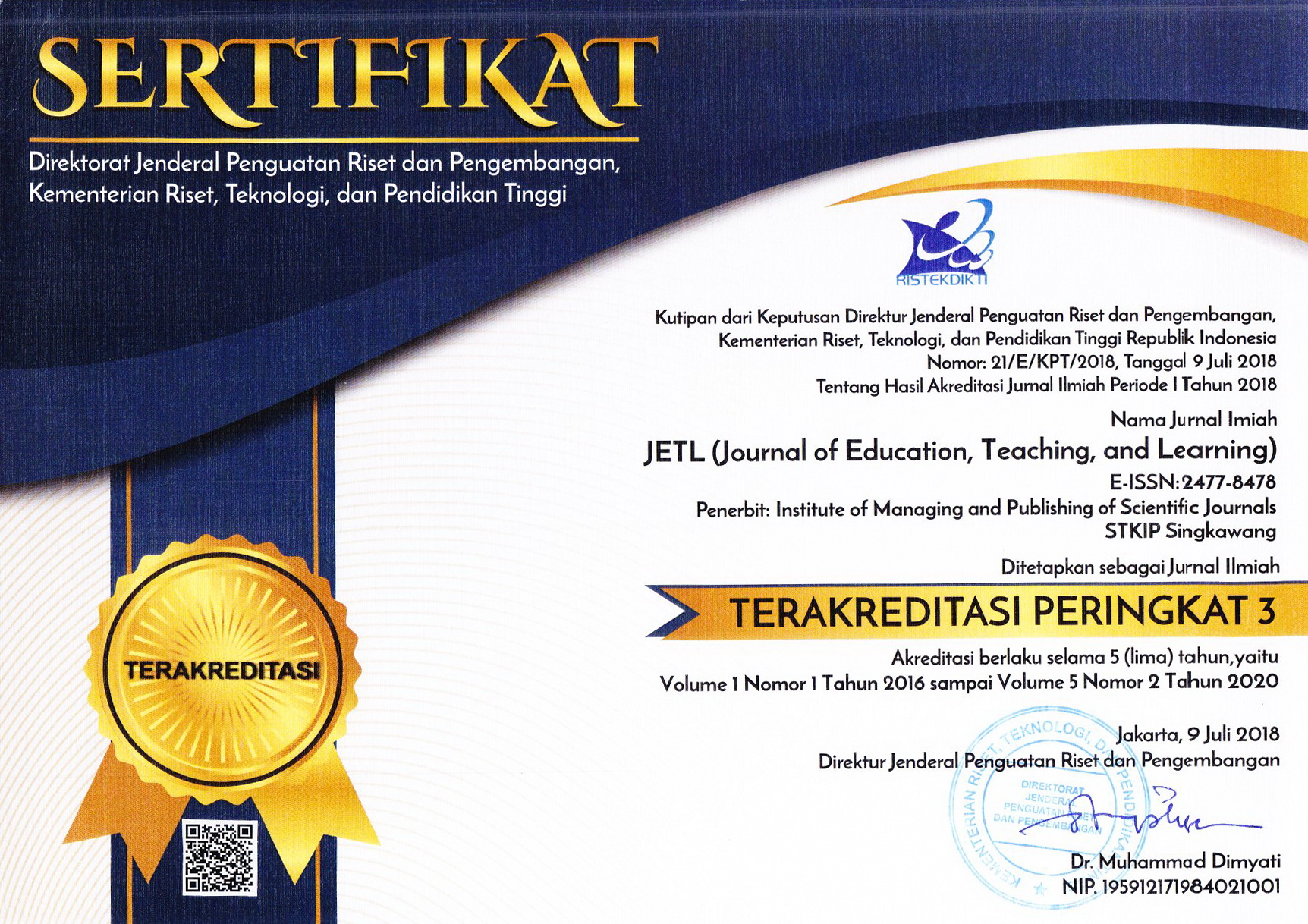


The Relationship Of Reflective Thinking Skills And Critical Thinking Skills In Science Problem Solving
Abstract
To be a good science teacher requires reflective thinking skills and critical thinking skills, both of which play an important role in scientific problem solving activities. Theoretically, there is a relationship between reflective thinking and critical skills, but empirical testing is needed. The aim of this research is to see the relationship between reflective thinking skills and critical thinking skills in the science problem solving activities. This research is included in correlational research, with a research population of prospective elementary school teacher students in semester 4 at Muhammadiyah University Prof. Dr. Hamka is taking a science education course. The research sample consisted of 48 students. Simple random sampling is used in the sampling technique. The data analysis technique uses the Spearman correlation test to test the relationship between the two variables and a simple linear regression test to predict the linear relationship between the two variables. Based on research findings, there is a significant relationship between reflective thinking skills and critical thinking skills in problem solving activities with a correlation value of 0.779 (very strong). Apart from that, there is also a linear relationship between these two variables so that the critical thinking skills score can be predicted using the regression equation Y = 82.485 + 1.144X.
Keywords
Full Text:
PDFReferences
Akerson, V. L., Carter, I. S., Rogers, M. A. P., & Pongsanon, K. (2018). A video-based measure of preservice teachers’ abilities to predict elementary students’ scientific reasoning. International Journal of Education in Mathematics, Science and Technology, 6(1), 79–92. https://doi.org/10.18404/ijemst.328335
Anderson, L. W., & Krathwohl, D. R. (2001). 2001. A Taxonomy for Learning, Teaching, and Assesing: A Rev ision of Bloom’s Taxonomy of Educational Objectives. New York: Addison Wesley Longman, Inc. Addison Wesley Longman, Inc.
Arifin, Z. (2025). The effect of inquiry-based learning on students ’ critical thinking skills in science education : A systematic review and meta-analysis. EURASIA Journal of Mathematics, Science and Technology Education, 21(3).
Aryani, F., Rais, M., & Wirawan, H. (2017). Reflective learning model in improving student critical thinking skills. Global Journal of Engineering Education, 1(1), 19–23.
Bayar, M. F., & Kurt, U. (2021). The Effect of Using Smart Boards in Science Lessons on Middle School Students’ Attitudes Towards Smartboards and Reflective Thinking Skills. Educational Policy Analysis and Strategic Research, 16(3), 23–38. https://doi.org/10.29329/epasr.2021.373.2
Bedford, D. (2010). Agnotology as a teaching tool: Learning climate science by studying misinformation. Journal of Geography, 109(4), 159–165. https://doi.org/10.1080/00221341.2010.498121
Bezanilla, M. J., Fernández-Nogueira, D., Manuel, M. P., & Galindo-Domínguez, H. (2019). Methodologies for teaching-learning critical thinking in higher education: The teacher’s view. Thinking Skills and Creativity. https://doi.org/10.1016/j.tsc.2019.100584
Can, S. (2015). Pre-service science teachers reflective thinking skills toward problem solving. Educational Research and Reviews, 10(10), 1449–1457. https://doi.org/10.5897/err2015.2228
Creswell, J. W., & Creswell, J. D. (2018). Research Design: Qualitative, Quantitative, and Mixed Methods Approaches (5th ed.). Sage Publication, Inc.
Demir, S. (2015). Evaluation of Critical Thinking and Reflective Thinking Skills among Science Teacher Candidates. Journal of Education and Practice, 6(18), 17–21. www.iiste.org
Deniş-Çeliker, H., & Dere, S. (2022). The Effects of The Problem-Based Learnıng Supported by Experiments in Science Course: Students’ Inquiry Learning and Reflective Thinking Skills. Journal of Science Learning, 5(1), 14–27. https://doi.org/10.17509/jsl.v5i1.32076
Dewey, J. (1933). How we think: A restatement of the relation of reflective thinking to the educative process. Heath and Company.
Eğmir, E., & Ocak, İ. (2020a). Prediction Level of the Fourth Grade Students’ Scientific Attitudes on Reflective Thinking Skills for Problem Solving. Open Journal for Educational Research, 4(2), 87–102. https://doi.org/10.32591/coas.ojer.0402.02087e
Eğmir, E., & Ocak, İ. (2020b). The Relationship Between Teacher Candidates’ Critical Thinking Standards and Reflective Thinking Skills. International Journal of Progressive Education, 16(3), 156–170. https://doi.org/10.29329/ijpe.2020.248.12
Ellianawati, Rusdiana, D., Sabandar, J., & Subali, B. (2017). Development of cognitive apprenticeship instruction model in mathematical physics learning to improve reflective thinking skills. International Conference On Education, November, 1–9.
Field, A. (2013). Discovering Statistics Using IBM SPSS Statistics (4th ed.). Sage Publication, Inc.
Fraenkel, J. R., Wallen, N. E., & Hyun, H. H. (2019). How to Design and Evaluate Research in Education (10th ed.). McGraw-Hill.
García-carmona, A. (2025). Scientific Thinking and Critical Thinking in Science Education Two Distinct but Symbiotically Related Intellectual Processes. Science & Education, 34(1), 227–245. https://doi.org/10.1007/s11191-023-00460-5
Ghanizadeh, A. (2017). The interplay between reflective thinking, critical thinking, self-monitoring, and academic achievement in higher education. Higher Education, 74(1), 101–114. https://doi.org/10.1007/s10734-016-0031-y
Gogus, A., Gogus, N. G., & Bahadir, E. (2020). Intersections between Critical Thinking Skills and Reflective Thinking Skills toward Problem Solving. Pamukkale University Journal of Education, 49, 1–19. https://doi.org/10.9779/pauefd.526407
Gulen, S., & Yaman, S. (2019). The Effect of Integration of STEM Disciplines into Toulmin’s Argumentation Model on Students’ Academic Achievement, Reflective Thinking, and Psychomotor Skills*. Journal of Turkish Science Education, 16(2), 216–230. https://doi.org/10.12973/tused.10276a
Gurol, A. (2011). Determining the reflective thinking skills of pre-service teachers in learning an teaching process. EESR Part B Social and Educational Studies, 3, 387–402.
Hindrasti, N. E. K. (2020). The reflective thinking skills of preservice biology teacher in histology lectures. Journal of Physics: Conference Series, 1470(1). https://doi.org/10.1088/1742-6596/1470/1/012080
Junsay, M. (2016). Reflective learning and prospective teachers’ conceptual understanding, critical thinking, problem solving, and mathematical communication skills. Research in Pedagogy, 6(2), 43–58. https://doi.org/10.17810/2015.34
Kazu, H., & Demiralp, D. (2012). A Study on Teachers’ Perceptions of the Effect of the Primary Education Curricula (1st-5th Grades) on the Development of Reflective Thinking in terms of Some Variables. Journal of Theoretical Educational Science, 5(4), 412–432.
Kember, D., Leung, D. Y. P., Jones, A., Loke, A. Y., McKay, J., Sinclair, K., Tse, H., Webb, C., Wong, F. K. Y., Wong, M., & Yeung, E. (2000). Development of a questionnaire to measure the level of reflective thinking. Assessment and Evaluation in Higher Education, 25(4), 381–395. https://doi.org/10.1080/713611442
Kobylarek, A., Błaszczyński, K., Ślósarz, L., & Madej, M. (2022). Critical Thinking Questionnaire (CThQ) – construction and application of critical thinking test tool. Andragogy Adult Education and Social Marketing, 2(2), 1. https://doi.org/10.15503/andr2022.1
Kosslyn, S. M. (2005). Reflective thinking and mental imagery: A perspective on the development of posttraumatic stress disorder. Development and Psychopathology, 17(3), 851–863. https://doi.org/10.1017/S0954579405050406
Kurt, M. (2018). Quality in reflective thinking: elicitation and classification of reflective acts. Quality and Quantity, 52(s1), 247–259. https://doi.org/10.1007/s11135-017-0609-1
Leung, D. Y. P., & Kember, D. (2010). Educational Psychology : An International Journal of Experimental The Relationship Between Approaches to Learning and Reflection Upon Practice. October 2014, 37–41. https://doi.org/10.1080/01443410303221
Manalo, E., Kusumi, T., Koyasu, M., Michita, Y., & Tanaka, Y. (2013). To what extent do culture-related factors influence university students’ critical thinking use? Thinking Skills and Creativity, 10, 121–132. https://doi.org/10.1016/j.tsc.2013.08.003
Mishra, P., Pandey, C. M., & Singh, U. (2019). Descriptive Statistics and Normality Tests for Statistical Data. Ann Card Anaesth, 22, 67–72. https://doi.org/10.4103/aca.ACA
Moeti, B., Killion Mgawi, R., & Smitta Moalosi, W. T. (2016). Critical Thinking among Post-Graduate Diploma in Education Students in Higher Education: Reality or Fuss? Journal of Education and Learning, 6(2), 13. https://doi.org/10.5539/jel.v6n2p13
Noor, S., & Tajik, O. (2022). Defining Simple Random Sampling in a Scientific Research. International Journal of Education & Language Studies, 1(November), 78–82.
Osborne, J. (2014). Teaching critical thinking ? New directions in science education. School Science Review, 95(352), 53–62.
Pedrosa-de-Jesus, H., Moreira, A., Lopes, B., & Watts, M. (2014). So much more than just a list: Exploring the nature of critical questioning in undergraduate sciences. Research in Science and Technological Education, 32(2), 115–134. https://doi.org/10.1080/02635143.2014.902811
Phan, H. P. (2011). Deep Processing Strategies and Critical Thinking : Developmental Trajectories. The Journal of Educational Research, 104(4), 283–294. https://doi.org/10.1080/00220671003739382
Pretorius, L., Van Mourik, G. P., & Barratt, C. (2017). Student Choice and Higher-Order Thinking: Using a Novel Flexible Assessment Regime Combined With Critical Thinking Activities to Encourage the Development of Higher Order Thinking. International Journal of Teaching, 29(2), 389–401. http://www.isetl.org/ijtlhe/
Sabekti, A. W., Maritim, U., Ali, R., Khoirunnisa, F., Maritim, U., Ali, R., & Liliasari, L. (2020). Validating the Indonesian Version of Reflective Thinking Questionnaire and Investigation of the Relationship Between Pre-Service Teachers ’ Reflective Thinking and Academic Achievem ... Validating the Indonesian Version of Reflective Thinking Questionnair. Companion Proceedings of the SEADRIC 2019, January, 138–144. https://doi.org/10.24071/seadr.2019.19
Saputra, M. D., Joyoatmojo, S., Wardani, D. K., & Sangka, K. B. (2019). Developing critical-thinking skills through the collaboration of Jigsaw model with problem-based learning model. International Journal of Instruction, 12(1), 1077–1094. https://doi.org/10.29333/iji.2019.12169a
Sezer, R. (2010). Effects of reflective writing in mathematics methods courses on pre-service teachers’ perceptions. Eurasian Journal of Educational Research, 40, 1–15.
Sinensis, A. R., Firman, H., Hamidah, I., & Muslim. (2020). Reflective thinking on thermodynamic learning based collaborative problem solving. Journal of Physics: Conference Series, 1521(2), 0–4. https://doi.org/10.1088/1742-6596/1521/2/022046
Titus, A. (2024). Reflective thinking in school: a systematic review. International Journal of Evaluation and Research in Education, 13(2), 742–751. https://doi.org/10.11591/ijere.v13i2.26573
Ulia, N., Waluya, S. B., Hidayah, I., & Pujiastuti, E. (2024). The relation of complex problem solving with reflective abstraction : a systematic literature review. International Journal of Evaluation and Research in Education, 13(3), 2020–2031. https://doi.org/10.11591/ijere.v13i3.26358
Vieira, R. M., & Tenreiro-Vieira, C. (2016). Fostering Scientific Literacy and Critical Thinking in Elementary Science Education. International Journal of Science and Mathematics Education, 14(4), 659–680. https://doi.org/10.1007/s10763-014-9605-2
Wahidin, D., & Romli, L. A. M. (2020). Students critical thinking development in the national sciences and mathematics competition in Indonesia: A descriptive study. Jurnal Pendidikan IPA Indonesia, 9(1), 106–115. https://doi.org/10.15294/jpii.v9i1.22240
Yacoubian, H. A. (2015). A Framework for Guiding Future Citizens to Think Critically About Nature of Science and Socioscientific Issues. Canadian Journal of Science, Mathematics and Technology Education, 15(3), 248–260. https://doi.org/10.1080/14926156.2015.1051671
DOI: http://dx.doi.org/10.26737/jetl.v10i1.6159
Refbacks
- There are currently no refbacks.


This work is licensed under a Creative Commons Attribution-NonCommercial 4.0 International License.
Published by:
Institute of Managing and Publishing of Scientific Journals STKIP Singkawang
Sekolah Tinggi Keguruan dan Ilmu Pendidikan (STKIP) Singkawang
Address : STKIP Singkawang, Jalan STKIP - Kelurahan Naram Singkawang, Kalimantan Barat, INDONESIA, 79251
No. Telp. : +62562 420 0344
No. Fax. : +62562 420 0584
JETL (Journal of Education, Teaching, and Learning)
e-ISSN : 2477-8478
p-ISSN : 2477-5924

Editor in Chief Contact: [email protected] / Wa: +6285245101122
Publisher Contact: [email protected] / Wa: +6281217024040/+6285750845033
Management Tools



JETL Indexed by: