Email this article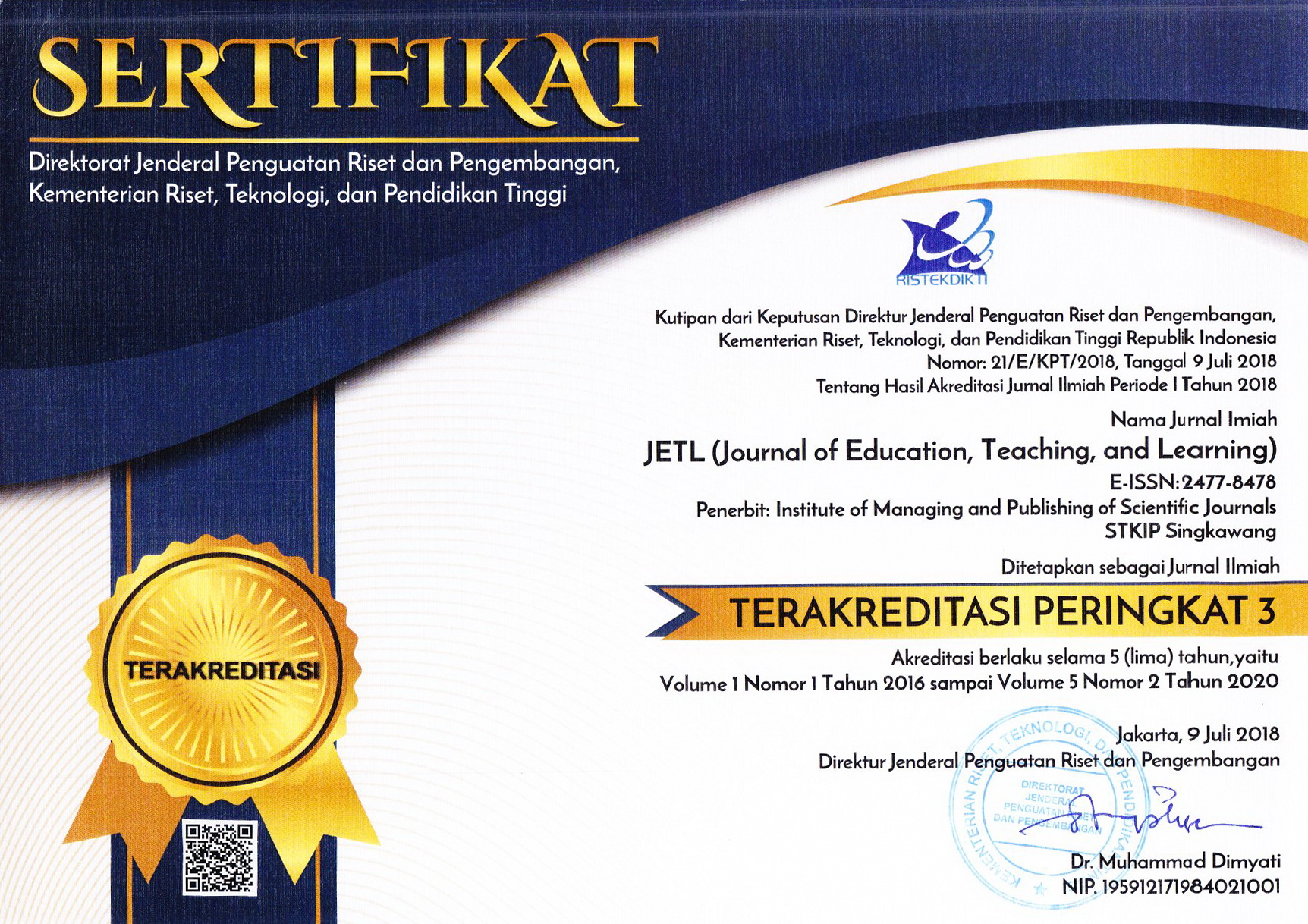


Problem Solving Ability Of Perspective Pre Teacher: A Pisa On Uncertainty And Data Content
Abstract
Keywords
Full Text:
PDFReferences
(OECD), O. for E. C. and D. (2023). Programme for International Student Assessment (PISA) 2022. Organisation for Economic Co-Operation and Development (OECD).
Adeoye, M. A., & Jimoh, H. A. (2023). Problem-Solving Skills Among 21st-Century Learners Toward Creativity and Innovation Ideas. Thinking Skills and Creativity Journal, 6(1), 52–58. https://doi.org/10.23887/tscj.v6i1.62708
Aljaberi, N. M., & Gheith, E. (2016). Pre-Service Class Teacher’ Ability in Solving Mathematical Problems and Skills in Solving Daily Problems. Higher Education Studies, 6(3), 32. https://doi.org/10.5539/hes.v6n3p32
Anam, K., Wiradharma, G., Suryani, N., & Sudarwo, R. (2021). Peran Kompetensi Guru terhadap Problem Solving Siswa. Journal of Education and Instruction (JOEAI), 4(2), 364–372. https://doi.org/10.31539/joeai.v4i2.2663
Andri Nugroho, A., & Dwijayanti, I. (2019). Analisis Kemampuan Pemecahan Masalah Mahasiswa Calon Guru Matematika Pada Mata Kuliah Program Linier 1. AKSIOMA: Jurnal Matematika Dan Pendidikan Matematika, 10(2), 277–284.
Barham, A. I. (2020). Investigating the development of pre-service teachers’ problem-solving strategies via problem-solving mathematics classes. European Journal of Educational Research, 9(1), 129–141. https://doi.org/10.12973/eu-jer.9.1.129
Bariyyah, K. (2021). Problem solving skills: esssential skills challenges for the 21st century graduates. Jurnal EDUCATIO: Jurnal Pendidikan Indonesia, 7(1), 71. https://doi.org/10.29210/120212843
Branca, N. . (1980). Problem Solving as a Goal, Process and Basic Skill. Dalam Krulik,S dan Reys,R.E (ed). Problem Solving in School Mathematics.
Darma, Y., Firdaus, M., & Haryadi, R. (2016). Hubungan Kemandirian Belajar terhadap Kemampuan Pemecahan Masalah Matematis Mahasiswa Calon Guru Matematika. Jurnal Edukasi, 14(1), 169–178.
Fazzilah, E., Nia, K., Effendi, S., & Marlina, R. (2020). Analisis Kesalahan Siswa Dalam Menyelesaikan Soal PISA Konten Uncertainty and Data. Jurnal Cendikia: Jurnal Pendidikan Matematika, 04(02), 1034–1043.
Harahap, R. (2022). Analisis Kemampuan Pemecahan Masalah Soal Rutin dan Non-Rutin pada Mata Kuliah Kapita Selekta Matematika Sekolah. Edukatif Jurnal Ilmu Pendidikan, 4(3), 3470–3478.
Hasibuan, S. A., & Fauzi, K. M. S. M. A. (2020). Development of PISA Mathematical Problem Model on the Content of Change and Relationship to Measure Students Mathematical Problem-Solving Ability. 15(2).
Julianawati, A. A., Darmawan, P., & Malang, U. N. (2025). Proses pemecahan masalah peluang oleh calon guru matematika berdasarkan kerangka polya. ELIPS: Jurnal Pendidikan Matematika, 6(1), 17–33.
Junika, N., Izzati, N., & Tambunan, L. R. (2020). Pengembangan Soal Statistika Model PISA untuk Melatih Kemampuan Literasi Statistika Siswa. Mosharafa : Jurnal Pendidikan Matematika, 9(September), 499–510.
Kemdikbud. (2021). Apa itu rapor pendidikan. https://pusatinformasi.raporpendidikan.kemdikbud.go.id/hc/en-us/articles/6545029651609-Tentang-Rapor-Pendidikan-dan-Rapor-Mutu
Kurniawati, I., Raharjo, T. J., & Khumaedi. (2019). Peningkatan Kemampuan Pemecahan Masalah untuk Mempersiapkan Generasi Unggul Menghadapi Tantangan abad 21. Seminar Nasinal Pascasarjana, 21(2), 702.
Luthfiyah, R. (2022). Analisis Kemampuan Pemecahan Masalah Mahasiswa Calon Guru Matematika Pada Materi Aritmetika Sosial. Jurnal Pendidikan Matematika Undiksha, 12(2), 34–37. https://doi.org/10.23887/jjpm.v12i2.34630
Meldi, N. F., Khoriyani, R. P., Susanti, W., Ahmad, D., & Rif’at, M. (2022). Implementasi Teknologi Digital Dalam Perkuliahan Matakuliah Kalkulus Integral Dalam Penyelesaian Luas Daerah Antarkurva. Jurnal Alwatzikhoebillah : Kajian Islam, Pendidikan, Ekonomi, Humaniora, 8(2), 156–167. https://doi.org/10.37567/alwatzikhoebillah.v8i2.1506
Meldi, N. F., Sugiatno, Hartoyo, A., Rif’at, M., & Nursangaji, A. (2023). Development of mathematics teaching materials in form of QR code based Al-Qur’an sourced leaflets. Aksioma, 12(4), 3613–3626.
Meria Uktra Gusteti, N. (2022). Pembelajaran berdiferensiasi pada pembelajaran matematika di kurikulum merdeka. Lebesgue: Jurnal Ilmiah Pendidikan Matematika, Matematika Dan Statistika, 3(3), 636–646.
Mutia, K. E. dan S. (2021). PISA -LIKE : Uncertainty and data content in Statistics subject with futsal context. Seminar Nasional Matematika Dan Pendidikan Matematika (SEMADIK) 2020, 1778, 1–9. https://doi.org/10.1088/1742-6596/1778/1/012028
NCTM. (2000). Principles and Standards for School Mathematics.
Nissa, I. C., & Lestari, P. (2015). Analisis Kemampuan Problem Solving Mahasiswa Calon Guru Matematika Berdasarkan Standar PISA. Jurnal Kependidikan, 14(1), 45.
Nugroho, A. A., & Dwijayanti, I. (2019). Analisis Kemampuan Pemecahan Masalah Mahasiswa Calon Guru Matematika Pada Mata Kuliah Program Linier. AKSIOMA : Jurnal Matematika Dan Pendidikan Matematika, 10(2), 277–284. https://doi.org/10.26877/aks.v10i2.4720
Nusantara, D. sapta, Zulkardi, & Putri, R. I. I. (n.d.). Kumpulan Soal PISA Matematika (PISACOMAT).
OECD. (1967). PISA 2021 MATHEMATICS FRAMEWORK (DRAFT). 2nd draft 32-40. Angewandte Chemie International Edition, 6(11), 951–952., 5–24.
OECD. (2023). PISA 2022 Assessment and Analytical Framework.
Organisation for Economic Co-operation and Development. (2023). PISA 2022 Results The State of Learning and Equity in Education: Vol. I.
Pambudi, D. S., Ambarwati, R., Trapsilasiwi, D., & Yudianto, E. (2022). Pelatihan Penyusunan Soal Berfikir Tingkat Tinggi bagi Guru-Guru Matematika SMA di Jember. DINAMISIA, 6(6), 1413–1419.
Polya, G. (1985). How to Solve it, A New Aspect of Mathematical Method. Princeton University Press.
Sudarti, S. I. K. M. S. dan. (2021). Data literacy of high school students on physics learning. ICOLSSTEM 2020, 1839, 1–7. https://doi.org/10.1088/1742-6596/1839/1/012025
Sujadi, I., Kurniawati, I., Wulandari, A. N., Andriatna, R., & Puteri, H. A. (2023). The Abilities of Junior High School Students in Solving PISA- Like Mathematical Problems on Uncertainty and Data Contents. Jurnal Penelitian Dan Pengembangan Pendidikan, 7(1), 102–109.
Sumarni, Nuranita Adiastuty, Mohamad Riyadi, Dania Khairun Nisa, Alfin Muhammad Restu, I. T. L. (2023). Analisis Kemampuan Literasi Matematika Siswa SMP dalam Mengerjakan Soal PISA Uncertainty and Data Content. Aksioma, 12(1), 725–738.
Sumarni, S., Darhim, D., & Fatimah, S. (2021). Kemampuan Pemecahan Masalah Mahasiswa Calon Guru Matematika Sekolah Menengah Berdasarkan Tahapan Polya. AKSIOMA: Jurnal Program Studi Pendidikan Matematika, 10(3), 1396. https://doi.org/10.24127/ajpm.v10i3.3717
Suratman, D., Darma, Y., & Susiaty, U. D. (2022). Subject specific pedagogic : Problem solving skill and character pre-teacher mathematics in Indonesia Subject Specific Pedagogic : Problem Solving Skill and Character Pre-Teacher Mathematics in Indonesia. The International Conference on Mathematics and Learning Research (ICOMER), 020008(July).
Suratman, D., Yusmin, E., Sayu, S., Meldi, N. F., & Fitriawan, D. (2022). Exploring algebraic change and relationship : A qualitative study for aspiring mathematics teachers. Al-Jabar : Jurnal Pendidikan Matematika, 13(2), 467–481.
Sutrisno, U., & Adirakasiwi, A. G. (2019). Analisis Kemampuan Literasi Matematis pada Soal Berorientasi PISA Konten Uncertainty and Data Berdasarkan Jenis Kelamin. Sesiomadika, 1224–1235.
T. D. Wilson, Nigel Ford, David Ellis, Allen Foster, A. S. (2002). Uncertainty and Its Correlates. Journal of The American Socierty for Information Science and Technology, 53(9).
Tabuyo, A. T. (2024). Metacognition and Mathematical Problem-Solving Performance of Pre-Service Teachers. Pegem Journal of Education and Intruction, 14(4), 474–480. https://doi.org/10.47750/pegegog.14.04.45
Thamsir, T., Silalahi, D. W., & Soesanto, R. H. (2019). EFFORTS IN IMPROVING MATHEMATICAL PROBLEM-SOLVING SKILLS OF NON-ROUTINE PROBLEMS OF ONE-VARIABLE LINEAR EQUATIONS AND INEQUALITIES BY IMPLEMENTING THE PEER TUTORING METHOD. JOHME: Journal of Holistic Mathematics Education, 3(1), 96–107.
Viktory & Damianus. (2022). Urgensi Manajemen Rekrutmen Guru. Jurnal Pendidikan Dan Konseling, 4(6), 1–9.
Walters, L. M., Green, M. R., Goldsby, D., & Parker, D. (2018). Digital Storytelling as a Problem-Solving Strategy in Mathematics Teacher Education: How Making a Math-eo Engages and Excites 21st Century Students. International Journal of Technology in Education and Science (IJTES), 2(1), 1–16. www.ijtes.net
Yansen, D. (2022). Pengembangan Soal Matematika Tipe PISA dengan Konteks Cabang Olahraga Bulu Tangkis. Jurnal Inovasi Keguruan Dan Ilmu Pendidikan, 2(2), 210–217.
Yuntawati. (2017). Pengaruh Problem Posing Terhadap Kemampuan Penyelesaian Masalah Matematika Mahasiswa Calon Guru Matematika IKIP Mataram. Jurnal Ilmu Sosial Dan Pendidikan, 1(2), 126–133.
Zhuang, H. (2013). The Application Of Documented Problem Solving In College Introductory Statistics Courses. American Journal of Business Education, 6(6), 609–613.
Zuhri, M. S. (2019). Profil Kemampuan Penalaran Matematis dalam Pemecahan Masalah Pada Mahasiswa Calon Guru. Jurnal Ilmiah Pendidikan Matematika, 4(1), 1.
DOI: http://dx.doi.org/10.26737/jetl.v10i1.6039
Refbacks
- There are currently no refbacks.


This work is licensed under a Creative Commons Attribution-NonCommercial 4.0 International License.
Published by:
Institute of Managing and Publishing of Scientific Journals STKIP Singkawang
Sekolah Tinggi Keguruan dan Ilmu Pendidikan (STKIP) Singkawang
Address : STKIP Singkawang, Jalan STKIP - Kelurahan Naram Singkawang, Kalimantan Barat, INDONESIA, 79251
No. Telp. : +62562 420 0344
No. Fax. : +62562 420 0584
JETL (Journal of Education, Teaching, and Learning)
e-ISSN : 2477-8478
p-ISSN : 2477-5924

Editor in Chief Contact: [email protected] / Wa: +6285245101122
Publisher Contact: [email protected] / Wa: +6281217024040/+6285750845033
Management Tools



JETL Indexed by: