Email this article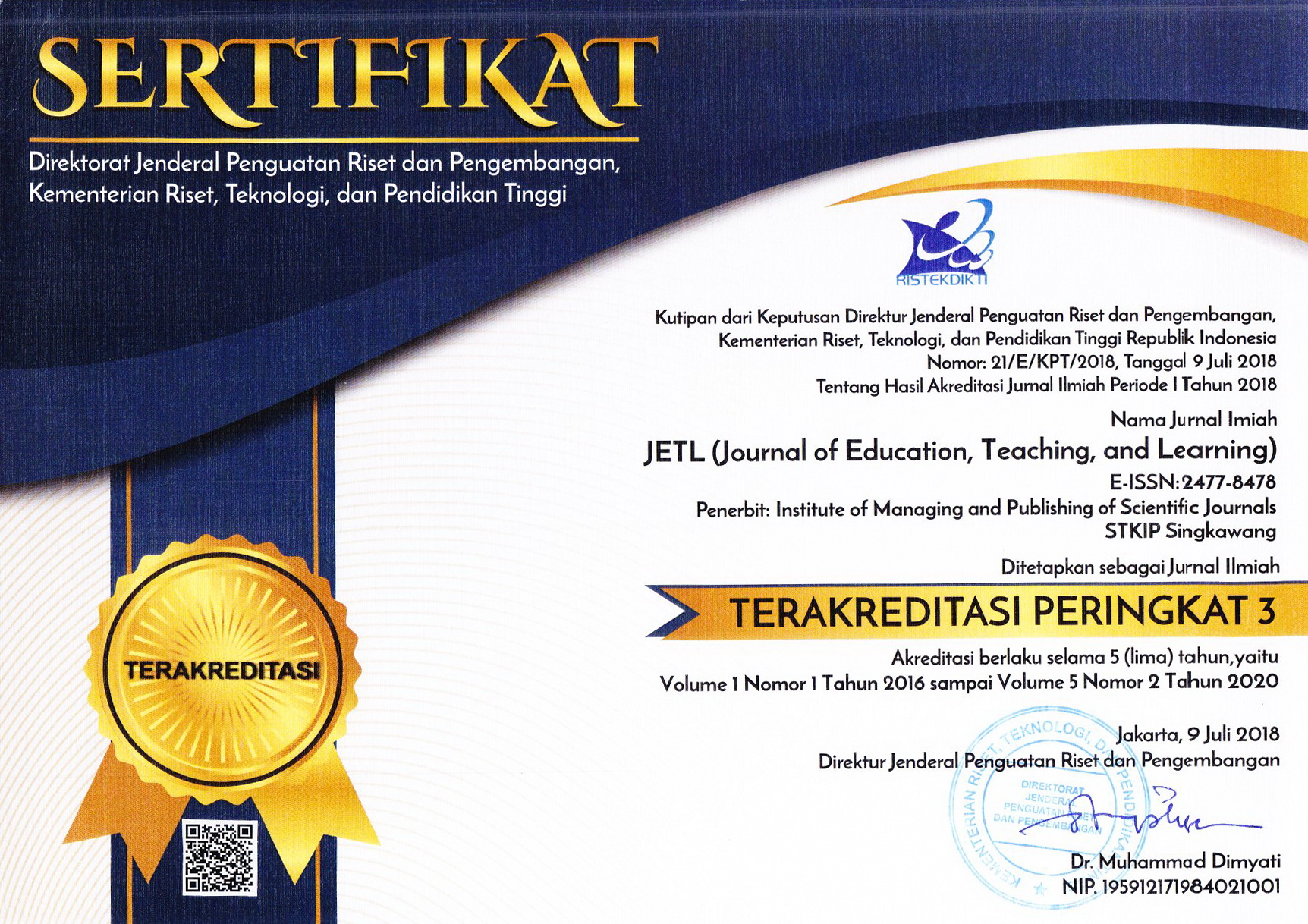


THE EFFECT OF CLAUDE AI-ASSISTED ASSESSMENT WITH ADAPTIVE PROMPTS ON REDUCING MATHEMATICS ANXIETY AMONG UNIVERSITY STUDENTS IN ABSTRACT ALGEBRA
Abstract
This study investigates the effect of Claude AI-assisted assessment with a purpose-built adaptive prompt system on reducing mathematics anxiety among university students in Abstract Algebra. Mathematics anxiety—a multidimensional affective construct distinct from general anxiety and from the cognitive barriers addressed in prior research on mathematical representation—constitutes a significant impediment to learning advanced mathematics. The study employed a mixed-methods design with an embedded experimental model involving 26 fourth-semester students of the Mathematics Education Study Program at Universitas PGRI Pontianak during the 2024/2025 academic year. The primary instrument was the Mathematics Anxiety Rating Scale–Revised (MARS-R) adapted into Indonesian and psychometrically validated (Cronbach's α = .91, CFI = .96). The Claude AI system was engineered with six adaptive prompt types—Calming Prompt, Stepwise Scaffolding, Positive Affirmation, Misconception Diagnosis, Metacognitive Reflection, and Progressive Feedback—automatically selected based on detected anxiety profiles. Results showed a highly significant reduction in mathematics anxiety (Z = −4.41, p < .001, r = .86). Mean scores declined from 46.7 (high) to 30.3 (low), a 35.1% reduction. The previously strong negative anxiety–achievement correlation (r = −.67, p < .001) became non-significant post-intervention (r = −.38, p = .054), indicating successful anxiety decoupling. These findings contribute to understanding affective dimensions in advanced mathematics learning and establish an empirical basis for adaptive AI in academic anxiety management.
Keywords
Full Text:
PDFReferences
Aiken, L. R. (1970). Attitudes toward mathematics. Review of Educational Research, 40(4), 551–596. https://doi.org/10.3102/00346543040004551
Alkan, V. (2022). The reasons of mathematics anxiety for undergraduate students. Procedia – Social and Behavioral Sciences, 46, 5194–5198.
Ashcraft, M. H., & Moore, A. M. (2009). Mathematics anxiety and the affective drop in performance. Journal of Psychoeducational Assessment, 27(3), 197–205. https://doi.org/10.1177/0734282908330580
Beilock, S. L., & Maloney, E. A. (2015). Math anxiety: A factor in math achievement not to be ignored. Policy Insights from the Behavioral and Brain Sciences, 2(1), 4–12. https://doi.org/10.1177/2372732215601438
Chan, C. K. Y., & Lee, K. K. W. (2023). The AI generation gap: Are Gen Z students more likely to accept artificial intelligence use in higher education? Social Psychology of Education, 26(5), 1267–1291.
Chang, H., & Beilock, S. L. (2016). The math anxiety–math performance link and its relation to individual and environmental factors. Current Opinion in Behavioral Sciences, 10, 33–38.
Cohen, J. (1992). A power primer. Psychological Bulletin, 112(1), 155–159. https://doi.org/10.1037/0033-2909.112.1.155
Dettmers, S., Trautwein, U., Lüdtke, O., Goetz, T., Frenzel, A. C., & Pekrun, R. (2011). Students' emotions during homework in mathematics. Contemporary Educational Psychology, 36(1), 25–35.
Fitriani, W., Yuwono, I., Sulandra, I. M., & As'ari, A. R. (2021). Mathematics anxiety of pre-service teachers in proving Abstract Algebra theorems. Journal of Education and Learning, 15(2), 183–191.
Fraenkel, J. R., Wallen, N. E., & Hyun, H. H. (2023). How to design and evaluate research in education (10th ed.). McGraw-Hill.
Gunderson, E. A., Park, D., Maloney, E. A., Beilock, S. L., & Levine, S. C. (2018). Reciprocal relations among motivational frameworks, math anxiety, and math achievement. Journal of Cognition and Development, 19(1), 21–46.
Hake, R. R. (1999). Analyzing change/gain scores. American Educational Research Association, Division D.
Hwang, G. J., & Tu, Y. F. (2021). Roles and research trends of artificial intelligence in mathematics education. Mathematics, 9(6), 584. https://doi.org/10.3390/math9060584
Jatisunda, M. G., & Nahdi, D. S. (2021). Self-efficacy in problem-based Abstract Algebra learning. Journal of Physics: Conference Series, 1778(1), 012013.
Luttenberger, S., Wimmer, S., & Paechter, M. (2018). Spotlight on math anxiety. Psychology Research and Behavior Management, 11, 311–322.
Ma, X. (1999). A meta-analysis of the relationship between anxiety toward mathematics and achievement in mathematics. Journal for Research in Mathematics Education, 30(5), 520–540.
Maloney, E. A., & Beilock, S. L. (2012). Math anxiety: Who has it, why it develops, and how to guard against it. Trends in Cognitive Sciences, 16(8), 404–406.
Nurhafizah, N., & Mahmudi, A. (2022). The effect of mathematics anxiety on students' problem-solving ability in Abstract Algebra. Journal on Mathematics Education, 13(3), 451–468.
Pekrun, R. (2006). The control-value theory of achievement emotions. Educational Psychology Review, 18(4), 315–341. https://doi.org/10.1007/s10648-006-9029-9
Plake, B. S., & Parker, C. S. (1982). The development and validation of a revised version of the Mathematics Anxiety Rating Scale. Educational and Psychological Measurement, 42(2), 551–557.
Richardson, F. C., & Suinn, R. M. (1972). The Mathematics Anxiety Rating Scale: Psychometric data. Journal of Counseling Psychology, 19(6), 551–554.
Santoso, D. H., Tambunan, W., & Gultom, S. (2022). Analysis of mathematics anxiety among students in HOTS-based Abstract Algebra learning. Journal on Mathematics Education, 13(2), 263–278.
Wang, Z., Rimfeld, K., Shakeshaft, N., Schofield, K., & Malanchini, M. (2020). The longitudinal role of mathematics anxiety in mathematics development. Journal of Adolescence, 80, 220–232.
DOI: http://dx.doi.org/10.26737/jetl.v10i2.8986
Refbacks
- There are currently no refbacks.


This work is licensed under a Creative Commons Attribution-NonCommercial 4.0 International License.
Published by:
Institute of Managing and Publishing of Scientific Journals STKIP Singkawang
Sekolah Tinggi Keguruan dan Ilmu Pendidikan (STKIP) Singkawang
Address : STKIP Singkawang, Jalan STKIP - Kelurahan Naram Singkawang, Kalimantan Barat, INDONESIA, 79251
No. Telp. : +62562 420 0344
No. Fax. : +62562 420 0584
JETL (Journal of Education, Teaching, and Learning)
e-ISSN : 2477-8478
p-ISSN : 2477-5924

Editor in Chief Contact: [email protected] / Wa: +6282142072788
Publisher Contact: [email protected] / Wa: +6282142072788
Management Tools



JETL Indexed by: