Email this article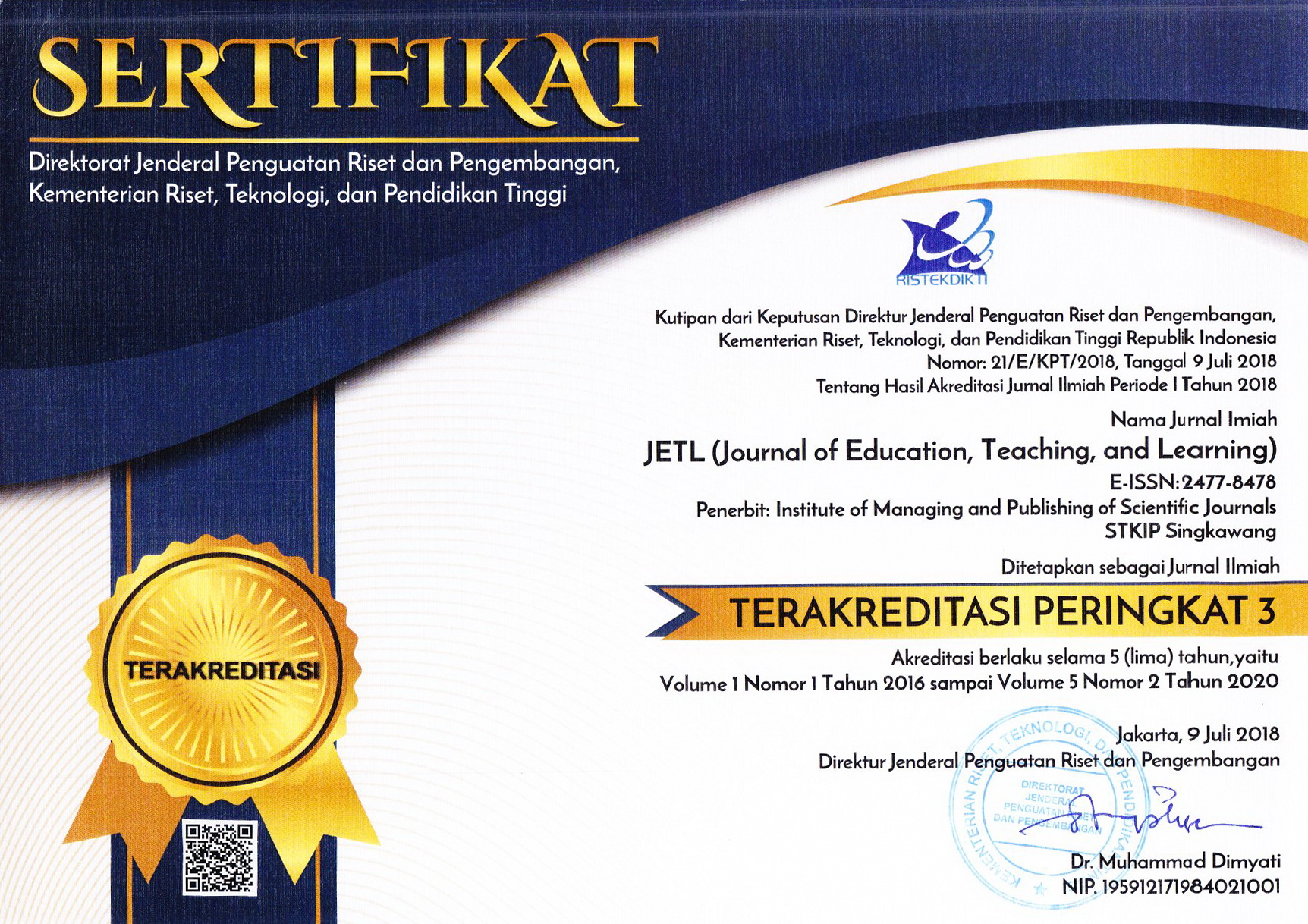


Analysis of Mathematical Problem Solving Ability of Junior High School Students Based on Polya's Stages in View of Math Anxiety Levels
Abstract
Keywords
Full Text:
PDFReferences
Agusantia, D. (2023). Kemampuan Penalaran Analogi Siswa dalam Menyelesaikan Masalah Matematis Bangun Ruang Prisma Berdasarkan Tingkat Kecemasan Matematika. Universitas Pendidikan Indonesia.
Anggarawati, G., Prasetyowati, D., & Zuhri, M. S. (2023). Analisis Kemampuan Pemecahan Masalah Matematika Ditinjau dari Kecemasan Matematika Siswa. Didaktik : Jurnal Ilmiah PGSD STKIP Subang, 09(05), 2541–2553. https://doi.org/10.36989/didaktik.v9i5.2346
Azzahra, R. H., & Pujiastuti, H. (2020). Analisis Kemampuan Pemecahan Masalah Siswa Pada Materi Sistem Persamaan Linear Tiga Variabel. Transformasi : Jurnal Pendidikan Matematika Dan Matematika, 4(1), 153–162. https://doi.org/10.36526/tr.v4i1.876
Casty, M. M., Ciriaka, M. G., & Peter, R. (2021). Mathematics Anxiety, Attitude and Performance Among Secondary School Students in Kenya. Educational Research and Reviews, 16(6), 226–235. https://doi.org/10.5897/ERR2021.4119
Commodari, E., & La Rosa, V. L. (2021). General academic anxiety and math anxiety in primary school. The impact of math anxiety on calculation skills. Acta Psychologica, 220, 103413. https://doi.org/10.1016/j.actpsy.2021.103413
Cuder, A., Živković, M., Doz, E., Pellizzoni, S., & Passolunghi, M. C. (2023). The relationship between math anxiety and math performance: The moderating role of visuospatial working memory. Journal of Experimental Child Psychology, 233. https://doi.org/10.1016/j.jecp.2023.105688
Erviana, E., Ningsih, Y. L., & Fitriasari, P. (2020). Analysis of Mathematical Problem Solving Ability of Junior High School Students on Relation & Function Material with Polya’s Strategy. Daya Matematis : Jurnal Inovasi Pendidikan Matematika, 8(3), 182–187. https://doi.org/10.26858/jdm.v8i3.15233
Fadila, L., Arjudin, Tyaningsih, R. Y., & Kurniati, N. (2024). Analisis Kemampuan Pemecahan Masalah Matematika Ditinjau Dari Minat Belajar Siswa. Journal of Classroom Action Research, 6(4), 838–843. https://doi.org/10.52166/inspiramatika.v8i2.3488
Firda, N., Suryadi, D., & Dahlan, J. A. (2023). Kemampuan Pemecahan Masalah Matematis Siswa Sekolah Menengah Pertama Berdasarkan Polya. Edumatica: Jurnal Pendidikan Matematika, 13(3). https://doi.org/10.22437/edumatica.v13i03.29287
Hakim, R. N., & Adirakasiwi, A. G. (2021). Analisis Tingkat Kecemasan Matematis Siswa SMA. 4(4), 809–816. https://doi.org/10.22460/jpmi.v4i4.809-816
Himawan, R. F., & Sulaiman, R. (2021). Analisis Kesalahan Siswa dalam Menyelesaikan Permasalah Matematika Menurut Teori Polya Ditinjau Berdasarkan Kecemasan Matematika. MATHEdunesa : Jurnal Ilmiah Pendidikan Matematika, 10(1), 1–9. https://doi.org/10.26740/mathedunesa.v10n1.p1-9
Holidun, Masykur, R., Suherman, S., & Putra, F. G. (2018). Kemampuan Pemecahan Masalah Matematis Kelompok Matematika Ilmu Alam dan Ilmu-Ilmu Sosial. Desimal: Jurnal Matematika, 1(1), 29. https://doi.org/10.24042/djm.v1i1.2022
Hunt, T. E., & Maloney, E. A. (2022). Appraisals of previous math experiences play an important role in math anxiety. Annals of the New York Academy of Sciences, 1515(1), 143–154. https://doi.org/10.1111/nyas.14805
Irawadi, A. A., Sripatmi, Junaidi, & Baidowi. (2025). Kemampuan Pemecahan Masalah Matematis Siswa Ditinjau dari Kepercayaan Diri dan Kecemasan Matematika. Journal of Classroom Action Research, 7(1). https://doi.org/10.29303/jcar.v7i1.10081
Kartikasari, L., & Kurniasari, I. (2021). Profil Berpikir Reflektif Siswa SMP dalam Menyelesaikan Soal PISA Ditinjau dari Kecemasan Matematika. Jurnal Cendekia : Jurnal Pendidikan Matematika, 5(3), 2878–2895. https://doi.org/10.31004/cendekia.v5i3.936
Kurniawati, A. D., & Siswono, T. Y. E. (2014). Pengaruh Kecemasan dan Self Efficacy Siswa terhadap Kemampuan Pemecahan Masalah Materi Segiempat Siswa Kelas VII MTs Negeri Ponorogo. Jurnal Ilmiah Pendidikan Matematika, 3(2), 39. https://doi.org/10.26740/mathedunesa.v3n2.p%25p
Luttenberger, S., Wimmer, S., & Paechter, M. (2018). Spotlight on math anxiety. Psychology Research and Behavior Management, 11, 311–322. https://doi.org/10.2147/PRBM.S141421
Mammarella, I. C., Caviola, S., & Dowker, A. (2019). Models of Math Anxiety. In Mathematics Anxiety. https://doi.org/10.4324/9780429199981-1
Manah, N. K., Isnarto, I., & Wijayanti, K. (2017). Analysis of Mathematical Problem Solving Ability Based on Student Learning Stages Polya on Selective Problem Solving Model. Unnes Journal of Mathematics Education, 6(1), 19–26. https://doi.org/10.15294/ujme.v6i1.10855
Millania, N. A., & Fauziyah, N. (2024). Analisis Kemampuan Pemecahan Masalah Matematis Siswa SMA dalam Menyelesaikan Soal Cerita SPLTV. Didactical Mathematics, 30(2), 202–2013. https://doi.org/10.31949/dm.v5i2.5480
Ojo, A., Oginni, O. G., Akinrinola, O. E., & Oginni, R. I. (2023). Impact of Cognitive-Behavioral Intervention on Alleviating Depression and Anxiety in Mathematics: Enhancing Students’ Learning Experience and Academic Performance. Voice of the Publisher, 09(04), 257–271. https://doi.org/10.4236/vp.2023.94020
Priyanto, D. (2017). Tingkat Dan Faktor Kecemasan Matematika Pada Siswa Sekolah Menengah Pertama. Jurnal Pendidikan Dan Pembelajaran Khatulistiwa (JPPK), 6(10), 1–11. https://doi.org/https://doi.org/10.26418/jppk.v6i10.22105
Ramirez, G., Shaw, S. T., & Maloney, E. A. (2018). Math Anxiety: Past Research, Promising Interventions, and a New Interpretation Framework. Educational Psychologist, 53(3), 145–164. https://doi.org/10.1080/00461520.2018.1447384
Rosiyanti, H., Ratnaningsih, D. A., Bahar, H., Iswan, & Faisal. (2021). Application of Mathematical Problem Solving Sheets in Polya’s Learning Strategy in Social Arithmetic Material. International Journal of Early Childhood Special Education, 13(2), 707–717. https://doi.org/10.9756/INT-JECSE/V13I2.211111
Safitri, R. R., Lukman, H. S., & Nurcahyono, N. A. (2022). Analisis Kemampuan Pemecahan Masalah Matematis Siswa Ditinjau Dari Kecemasan Matematis. Jurnal Cendekia : Jurnal Pendidikan Matematika, 6(3), 3469–3485. https://doi.org/10.31004/cendekia.v6i3.1571
Sari, R. M. M., Priatna, N., & Juandi, D. (2022). Analysis of High School Students Logical-Mathematical Thinking Ability Based on the Polya Stage Solving in Terms of Mathematical Self-Concept Ability. Prima: Jurnal Pendidikan Matematika, 6(1), 53. https://doi.org/10.31000/prima.v6i1.5316
Setiawan, M., Pujiastuti, E., & Susilo, B. E. (2021). Tinjauan Pustaka Systematik: Pengaruh Kecemasan Matematika Terhadap Kemampuan Pemecahan Masalah Siswa. QALAMUNA: Jurnal Pendidikan, Sosial, Dan Agama, 13(2), 239–256. https://doi.org/10.37680/qalamuna.v13i2.870
Taneo, P. N. L., & Kusumah, Y. S. (2021). Analysis of Students’ Mathematical Problem-Solving Ability Based on Category Levels Through Polya Steps. (Jiml) Journal of Innovative Mathematics Learning, 4(2), 87–95. https://doi.org/10.22460/jiml.v4i2.p87-95
Utami, R. W., & Wutsqa, D. U. W. (2017). Analisis Kemampuan Pemecahan Masalah Matematika dan Self-Efficacy Siswa SMP Negeri di Kabupaten Ciamis. Jurnal Terapan Abdimas, 4(2), 166–175. https://doi.org/10.25273/jta.v5i1.4642
Zhang, J., Zhao, N., & Kong, Q. P. (2019). The Relationship Between Math Anxiety and Math Performance: a Meta-Analytic Investigation. Frontiers in Psychology, 10(AUG), 1–17. https://doi.org/10.3389/fpsyg.2019.01613
DOI: http://dx.doi.org/10.26737/jetl.v10i2.7854
Refbacks
- There are currently no refbacks.


This work is licensed under a Creative Commons Attribution-NonCommercial 4.0 International License.
Published by:
Institute of Managing and Publishing of Scientific Journals STKIP Singkawang
Sekolah Tinggi Keguruan dan Ilmu Pendidikan (STKIP) Singkawang
Address : STKIP Singkawang, Jalan STKIP - Kelurahan Naram Singkawang, Kalimantan Barat, INDONESIA, 79251
No. Telp. : +62562 420 0344
No. Fax. : +62562 420 0584
JETL (Journal of Education, Teaching, and Learning)
e-ISSN : 2477-8478
p-ISSN : 2477-5924

Editor in Chief Contact: [email protected] / Wa: +6285245101122
Publisher Contact: [email protected] / Wa: +6281217024040/+6285750845033
Management Tools



JETL Indexed by: