Email this article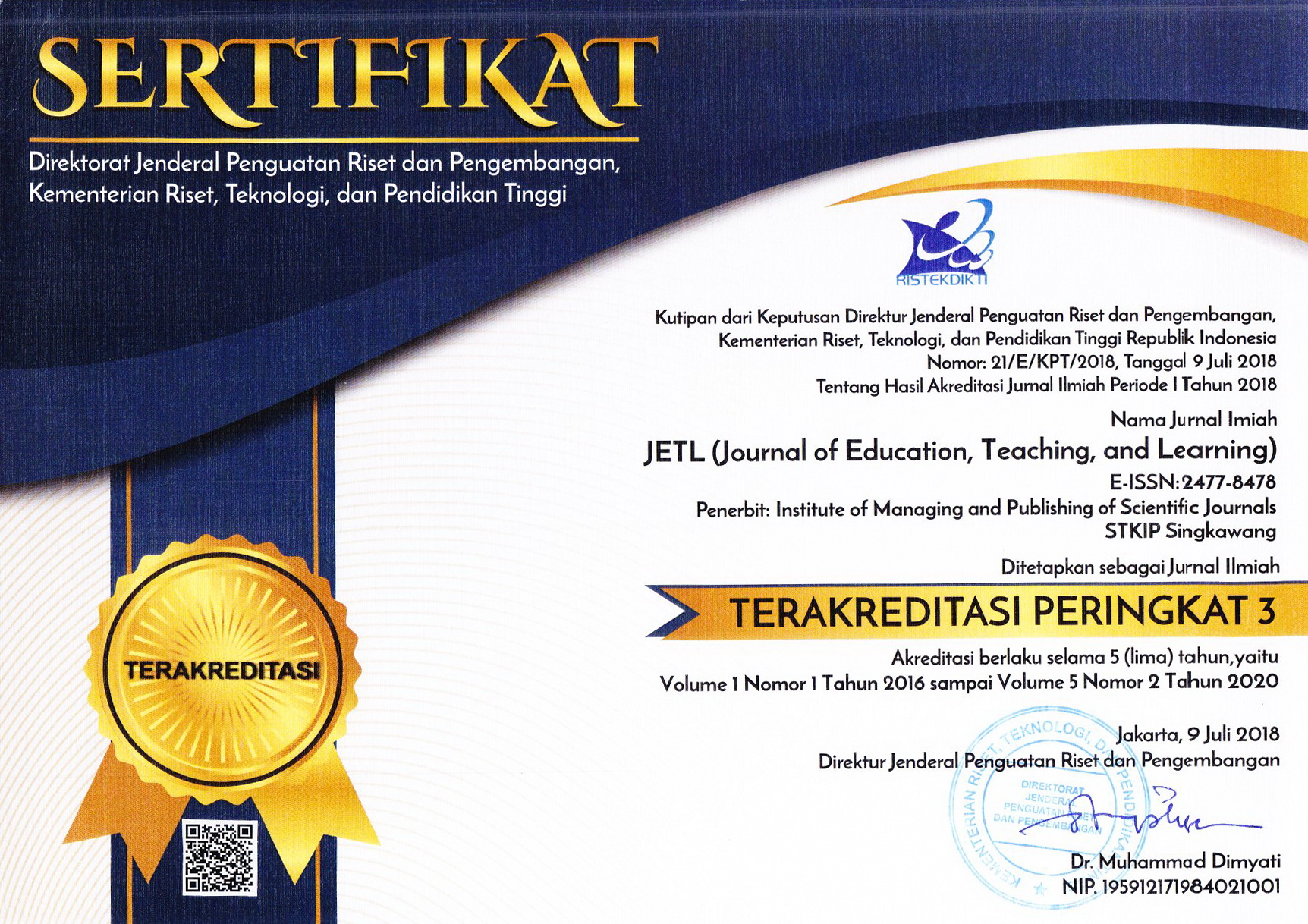


Digital Literacy in Matrilineal Family
Abstract
Keywords
Full Text:
PDFReferences
Anderson, J., Chung, Y. C., & Macleroy, V. (2018). Creative and critical approaches to language learning and digital technology: findings from a multilingual digital storytelling project. Language and Education, 32(3), 195-211. https://doi.org/10.1080/09500782.2018.1430151
Bawden, D. (2001). Information and digital literacies: a review of concepts. Journal of Documentation, 57(2), 218–259. https://doi.org/10.1108/EUM0000000007083
Cabello, P., Claro, M., Rojas, R., & Trucco, D. (2020). Children’s and adolescents’ digital access in Chile: the role of digital access modalities in digital uses and skills. Journal of Children and Media, 1–19. https://doi.org/10.1080/17482798.2020.1744176
Cincinnato, S., De Wever, B., Van Keer, H., & Valcke, M. (2016). The Influence of Social Background on Participation in Adult Education: Applying the Cultural Capital Framework. Adult Education Quarterly, 66(2), 143–168. https://doi.org/10.1177/0741713615626714
Disney, L., Connelly, E., & Waterhouse, B. (2017). Digital literacy-teacher and parent conversations. Practical Literacy: The Early and Primary Years, 22(3), 13. https://search.informit.org/doi/10.3316/INFORMIT.087157797581322
Dragiewicz, M., Woodlock, D., Harris, B., & Reid, C. (2019). Technology-facilitated coercive control. The Routledge International Handbook of Violence Studies, 244–253. https://doi.org/10.1080/14680777.2018.1447341
Fairlie, R. W., & Kalil, A. (2017). The effects of computers on children's social development and school participation: Evidence from a randomized control experiment. Economics of Education Review, 57, 10-19. https://doi.org/10.1016/j.econedurev.2017.01.001
Fernández-García, A., Poza-Vilches, F., & Llamas, J. L. G. (2019). Educational Needs of Spanish Youths at Risk of Social Exclusion: Future Challenges before School Failure. Journal of Educational, Cultural and Psychological Studies (ECPS Journal), (20), 59–82. https://doi.org/10.7358/ecps-2019-020-fern
Fırat, S., Gül, H., Sertçelik, M., Gül, A., Gürel, Y., & Kılıç, B. G. (2018). The relationship between problematic smartphone use and psychiatric symptoms among adolescents who applied to psychiatry clinics. Psychiatry Research, 270, 97–103. https://doi.org/10.1016/j.psychres.2018.09.015
Fischl, C., Blusi, M., Lindgren, H., & Nilsson, I. (2020). Tailoring to support digital technology-mediated occupational engagement for older adults–a multiple case study. Scandinavian Journal of Occupational Therapy, 1–14. https://doi.org/10.1080/11038128.2020.1760347
Gaulin, S. J., McBurney, D. H., & Brakeman-Wartell, S. L. (1997). Matrilateral biases in the investment of aunts and uncles. Human Nature, 8(2), 139-151. https://doi.org/10.1007/s12110-997-1008-4
Gegenfurtner, A., Schmidt-Hertha, B., & Lewis, P. (2020). Digital technologies in training and adult education. International Journal of Training and Development, 24(1), 1–4. https://doi.org/10.1111/ijtd.12172
Gleason B, Von Gillern S. Digital citizenship with social media: Participatory practices of teaching and learning in secondary education. Journal of Educational Technology & Society. 2018 Jan 1;21(1):200-12. https://www.jstor.org/stable/26273880
Harkin, D., & Molnar, A. (2020). Operating-System Design and Its Implications for Victims of Family Violence: The Comparative Threat of Smart Phone Spyware for Android Versus iPhone Users. Violence Against Women. https://doi.org/10.1177/1077801220923731.
Harris, I. M., & Harris, B. I. M. (2010). An undergraduate community education curriculum for community development AN UNDERGRADUATE COMMUNITY EDUCATION CURRICULUM FOR COMMUNITY DEVELOPMENT. (March 2015), 37–41. https://doi.org/10.1080/15575330.1982.9987142
Hartung, J. (1985). Matrilineal inheritance: New theory and analysis. Behavioral and Brain Sciences, 8(4), 661-670. https://doi.org/10.1017/S0140525X00045520
Indriyani, V. (2019). Digital Literacy Competencies for Teacher Education Students. 1st International Conference on Education Social Sciences and Humanities (ICESSHum 2019). Atlantis Press.DOI:10.2991/icesshum-19.2019.156
Isaac, E. P. (2011). Barriers to Adult Education Participation , Distance Education , and Adult Learning. 2011–2013. https://doi.org/10.4018/978-1-61692-906-0.ch067
Le, A.-V., Do, D.-L., Pham, D.-Q., Hoang, P.-H., Duong, T.-H., Nguyen, H.-N., … Vuong, Q.-H. (2019). Exploration of youth’s digital competencies: a dataset in the educational context of Vietnam. Data, 4(2), 69. https://doi.org/10.3390/data4020069
Livingstone, S. (2004). Media literacy and the challenge of new information and communication technologies. The Communication Review, 7(1), 3-14. https://doi.org/10.1080/10714420490280152
Matli, W., & Ngoepe, M. (2020). Capitalizing on digital literacy skills for capacity development of people who are not in education, employment or training in South Africa. African Journal of Science, Technology, Innovation and Development, 12(2), 129-139. https://journals.co.za/doi/abs/10.1080/20421338.2019.1624008
Mohammadyari, S., & Singh, H. (2015). Understanding the effect of e-learning on individual performance: The role of digital literacy. Computers & Education, 82, 11-25.
Murphy, S. (2018). The role of digital technology in teen mothers ’ and their children ’ s literacy. https://doi.org/10.1177/1468798418783326
Nabela, H. R., & Rianto, P. (2020). The Use of New Media Technology in Families and Its Impact on Intimacy. Asian Journal of Media and Communication, 4(2) https://doi.org/10.20885/asjmc.vol4.iss2.art3
Nelson, K., Courier, M., & Joseph, G. W. (2019). An investigation of digital literacy needs of students. Journal of Information Systems Education, 22(2), 2. https://aisel.aisnet.org/jise/vol22/iss2/2
Nutbrown, C., & Hannon, P. (2003). Children’s perspectives on family literacy: Methodological issues, findings and implications for practice. Journal of Early Childhood Literacy, 3(2), 115-145. https://doi.org/10.1177/14687984030032001
O’Reilly, M., Levine, D., & Law, E. (2020). Applying a ‘digital ethics of care’philosophy to understand adolescents’ sense of responsibility on social media. Pastoral Care in Education, 1–17. https://doi.org/10.1080/02643944.2020.1774635
Oberländer, M., Beinicke, A., & Bipp, T. (2020). Digital competencies: A review of the literature and applications in the workplace. Computers & Education, 146, 103752. https://doi.org/10.1016/j.compedu.2019.103752
Putri, L. D., Rozi, M. F., Handrianto, C., & Rahman, M. A. (2024). A conceptual family partnership model with Paud institutions in developing the potential of early children based on blended learning. Ensaio: Avaliação e Políticas Públicas em Educação, 32(125), e0244444. https://doi.org/10.1590/S0104-40362024003204444
Rodríguez-de-Dios, I., van Oosten, J. M. F., & Igartua, J.-J. (2018). A study of the relationship between parental mediation and adolescents’ digital skills, online risks and online opportunities. Computers in Human Behavior, 82, 186–198. https://doi.org/10.1016/j.chb.2018.01.012
Smythe, S. (2018). Adult learning in the control society: Digital era governance, literacies of control, and the work of adult educators. Adult Education Quarterly, 68(3), 197-214. https://doi.org/10.1177/0741713618766645
Statti, A., & Torres, K. M. (2020). Digital Literacy: The Need for Technology Integration and Its Impact on Learning and Engagement in Community School Environments. Peabody Journal of Education, 95(1), 90-100. https://doi.org/10.1080/0161956X.2019.1702426
Sturge-Apple, M. L., Li, Z., Martin, M. J., Jones-Gordils, H. R., & Davies, P. T. (2020). Mothers’ and fathers’ self-regulation capacity, dysfunctional attributions and hostile parenting during early adolescence: A process-oriented approach. Development and Psychopathology, 32(1), 229–241. https://doi.org/10.1017/S0954579418001694
Terras, M. M., & Ramsay, J. (2016). Family digital literacy practices and children’s mobile phone use. Frontiers in Psychology, 7, 1957. https://doi.org/10.3389/fpsyg.2016.01957
Van Velthoven, M. H., Powell, J., & Powell, G. (2018). Problematic smartphone use: Digital approaches to an emerging public health problem. SAGE Publications Sage UK: London, England. https://doi.org/10.1177/20552076187591
Woodlock, D., McKenzie, M., Western, D., & Harris, B. (2019). Technology as a weapon in domestic violence: Responding to digital coercive control. Australian Social Work, 1–13. https://doi.org/10.1080/0312407X.2019.1607510
DOI: http://dx.doi.org/10.26737/jetl.v10i1.6724
Refbacks
- There are currently no refbacks.


This work is licensed under a Creative Commons Attribution-NonCommercial 4.0 International License.
Published by:
Institute of Managing and Publishing of Scientific Journals STKIP Singkawang
Sekolah Tinggi Keguruan dan Ilmu Pendidikan (STKIP) Singkawang
Address : STKIP Singkawang, Jalan STKIP - Kelurahan Naram Singkawang, Kalimantan Barat, INDONESIA, 79251
No. Telp. : +62562 420 0344
No. Fax. : +62562 420 0584
JETL (Journal of Education, Teaching, and Learning)
e-ISSN : 2477-8478
p-ISSN : 2477-5924

Editor in Chief Contact: [email protected] / Wa: +6282142072788
Publisher Contact: [email protected] / Wa: +6282142072788
Management Tools



JETL Indexed by: