Email this article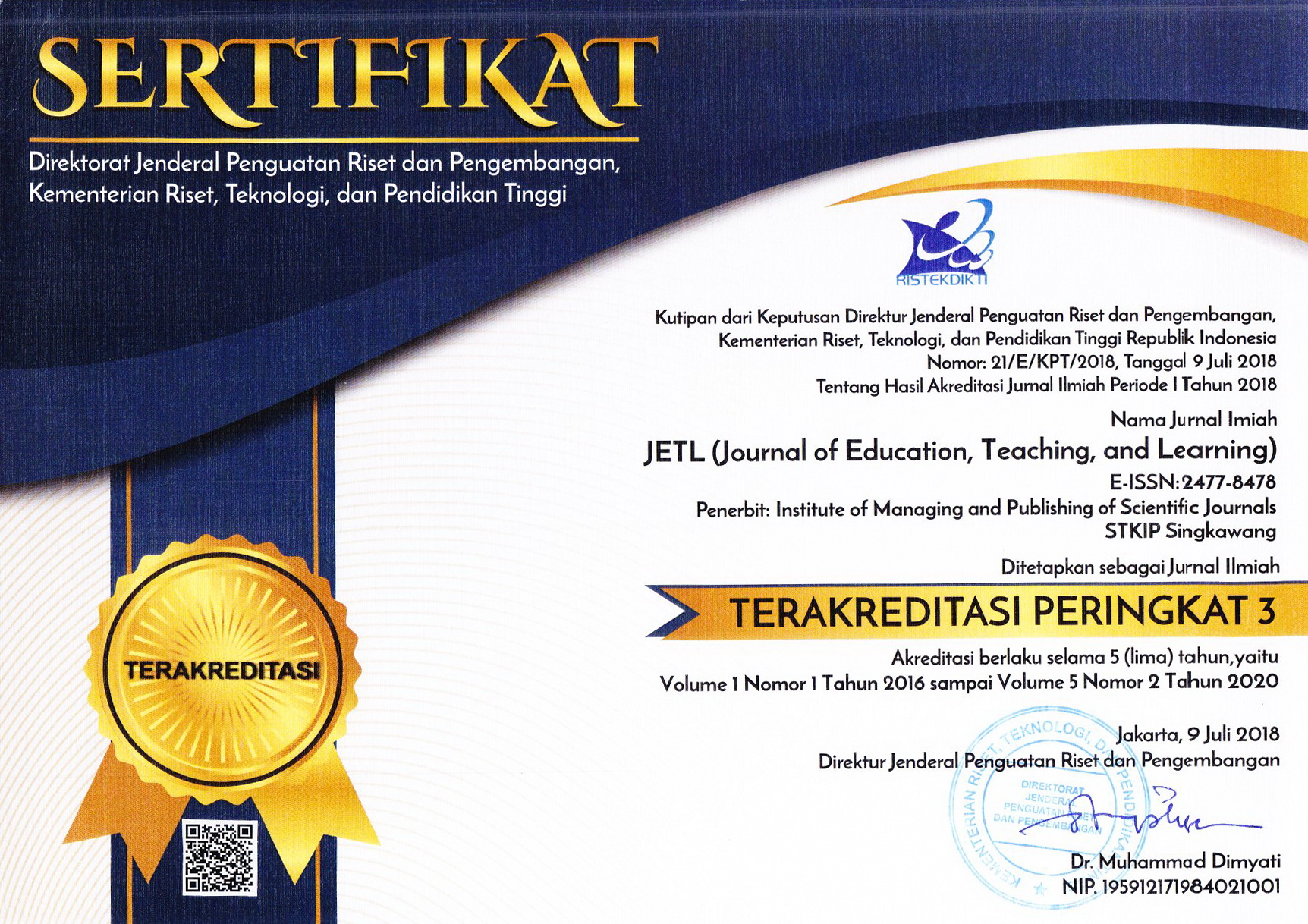


English Teachers’ Role in the 21st Century Learning
Abstract
Keywords
Full Text:
PDFReferences
Anggraini, P. P., Apriliani, N. A., Supeni, I., & Handrianto, C. (2022). The use of the cocomelon youtube channel as a medium for introducing children's english vocabulary. SAGA: Journal of English Language Teaching and Applied Linguistics, 3(2), 81-90. https://doi.org/10.21460/saga.2022.32.137
Atsoglou, K., & Jimoyiannis, A. (2012). Teachers ’ decisions to use ICT in classroom practice : An
investigation based on Decomposed Theory of Planned Behavior. May. https://doi.org/10.4018/jdldc.2012040102
Bryman, A. (2016). Social Research Method (5th ed.). Oxford UniversityPress.
Chineze., E. S P, Kaegon, L., & Chiemezie, Okata, F. (2016). Teachers’ Level of Awareness of
st Century Occupational Roles in Rivers State Secondary Schools. Journal of Education
and Training Studies, 4(8). https://doi.org/10.11114/jets.v4i8.1621
Chung, S. (2014). Pre-service and in- service ESL teachers ’ beliefs about the use of digital
technology in the classroom by Affairs in partial fulfillment of the requirements for the
degree of. https://doi.org/10.22215/etd%2F2014-10485
Creswell, J. W. (2012). No Titleیلیب. In Nucl. Phys. (Vol. 13, Issue 1).
https://books.google.co.id/books/about/Qualitative_Inquiry_and_Research_Design.html?id=OJYEbDtkxq8C&redir_esc=y
Davis, F. (1989). Perceived Usefulness, Perceived Ease of Use, and User Acceptance of
Information Technology. MIS Quarterly, 13, 318-341. http://dx.doi.org/10.2307/249008
Fatimah, A. S. dan S. (2017). Teaching In 21 st Century : Students- Teachers ’ Perceptions Of
Technology Use In The Classroom. 2(2). https://doi.org/10.24903/sj.v2i2.132
Fima, M. F., Melvina, M., & Yulmiati, Y. (2024). Leveraging Information and Communication
Technology (ICT) to Enhance EFL Students' 4C Skills. English Teaching and Linguistics
Journal (ETLiJ), 5(2), 182-193. https://doi.org/10.30596/etlij.v5i2.18896
Gilakjani, A. P., & Branch, L. (2012). EFL teachers’ beliefs toward using computer technology in
English language teaching. Journal of Studies in Education, 2(2), 62-80. https://doi.org/10.5296/jse.v2i2.1174
Handayani, N. (2018). Teachers’ Voice, Reformulating the Roles of English Teachers in 21st
Century. International Journal of Educational Science and Research, 8(3), 13–26.
https://doi.org/10.24247/ijesrjun20183
Jamil, N. L., Karmina, S., Muniroh, S. ., & Shafie, L. A. . (2023). Senior Female EFL Teachers’
Voices: Beliefs on ICT Implementation In EFL Classrooms. JEELS (Journal of English
Education and Linguistics Studies), 10(2), 379– 406. https://doi.org/10.30762/jeels.v10i2.1115
Junaidia, J., Hamuddinb, B., Simangunsongc, W., Rahmand, F., & Derine, T. (2020). ICT usage in
teaching english in pekanbaru: Exploring junior high school teachers’ problems. International Journal of Innovation, Creativity and Change, 12(4), 1–21. http://sersc.org/journals/index.php/IJAST/article/view/5725
Khairunnisa, N., Rahman, M., & Handrianto, C. (2022). English digital literacy practices inside and outside class to develop students’ speaking skills. Pedagogy: Journal of English Language Teaching, 10(1), 13-24. https://doi.org/10.32332/joelt.v10i1.3790
Mandasari, B., & Aminatun, D. (2022). Investigating Teachers’ Belief and Practices Toward Digital
Media of English Learning During Covid-19 Pandemic. English Review: Journal of English
Education, 10 (Vol 10, No 2 (2022)), 475–484.
https://journal.uniku.ac.id/index.php/ERJEE/article/view/6248/3095
Michiel Voet and Bram De Wever. (2017). Towards a differentiated and domain-specific view of
educational technology : An exploratory study of history teachers ’ technology use . 48.
https://doi.org/10.1111/bjet.12493
Nugroho, A., & Mutiaraningrum, I. (2020). EFL teachers beliefs and practices about digital learning
of English. EduLite: Journal of English Education, Literature and Culture, 5(2), 304.
https://doi.org/10.30659/e.5.2.304-321
Nugroho, T. C., & Matra, S. D. (2022). Efl Student Teacher’s Belief And Practice On Integrating
Ict In The Classroom (A Case Study on the Implementation of Online Learning in Edunovatica: Jurnal Inovasi …, 1(1), 49–60. https://jurnal.unikal.ac.id/index.php/edunovatica/article/vi ew/2258%0Ahttps://jurnal.unikal.ac.id/index.php/edunovatica/article/viewFile/2258/1253
Nurhidayat, E., Mujiyanto, J., Yuliasri, I., & Hartono, R. (2024). Technology integration and
teachers’ competency in the development of 21st-century learning in EFL classroom. Journal of Education and Learning (EduLearn), 18(2), 342-349.
https://doi.org/10.11591/edulearn.v18i2.21069
Putu, L., Adi, R., Padmadewi, N. N., & Artini, L. P. (2021). Teachers ’ Perceived Attitudes Toward
The Implementation of 21st Century Skills. April. https://doi.org/10.23887/ijll.v5i1.27667
Qaddumi, H., Smith, M., Masd, K., Bakeer, A., & Abu-Ulbeh, W. (2023). Investigating Palestinian
in-service teachers’ beliefs about the integration of information and communication
technology (ICT) into teaching English. Education and Information Technologies, 28(10),
-12805.
Rahmati, J., & Izadpanah, S. (2021). A meta-analysis on educational technology in English
language teaching. https://doi.org/10.1186/s40468-021-00121-w
Simonsson, M. (2004). Technology Use of Hispanic Bilingual Teachers: A Function of their
Beliefs. Attitudes and Perceptions on Peer Technology Use in the Classroom. Journal of
Instructional Psychology, 31(3), 257.
Sumardi, L., Rohman, A., & Wahyudiati, D. (2020). Does the teaching and learning process in
primary schools correspond to the characteristics of the 21st century learning? International
Journal of Instruction, 13(3), 357–370. https://doi.org/10.29333/iji.2020.13325a
Wrahatnolo, T., & Munoto. (2018). 21St Centuries Skill Implication on Educational System. IOP
Conference Series: Materials Science and Engineering, 296(1).
https://doi.org/10.1088/1757-899X/296/1/012036
DOI: http://dx.doi.org/10.26737/jetl.v10i1.6723
Refbacks
- There are currently no refbacks.


This work is licensed under a Creative Commons Attribution-NonCommercial 4.0 International License.
Published by:
Institute of Managing and Publishing of Scientific Journals STKIP Singkawang
Sekolah Tinggi Keguruan dan Ilmu Pendidikan (STKIP) Singkawang
Address : STKIP Singkawang, Jalan STKIP - Kelurahan Naram Singkawang, Kalimantan Barat, INDONESIA, 79251
No. Telp. : +62562 420 0344
No. Fax. : +62562 420 0584
JETL (Journal of Education, Teaching, and Learning)
e-ISSN : 2477-8478
p-ISSN : 2477-5924

Editor in Chief Contact: [email protected] / Wa: +6285245101122
Publisher Contact: [email protected] / Wa: +6281217024040/+6285750845033
Management Tools



JETL Indexed by: