Email this article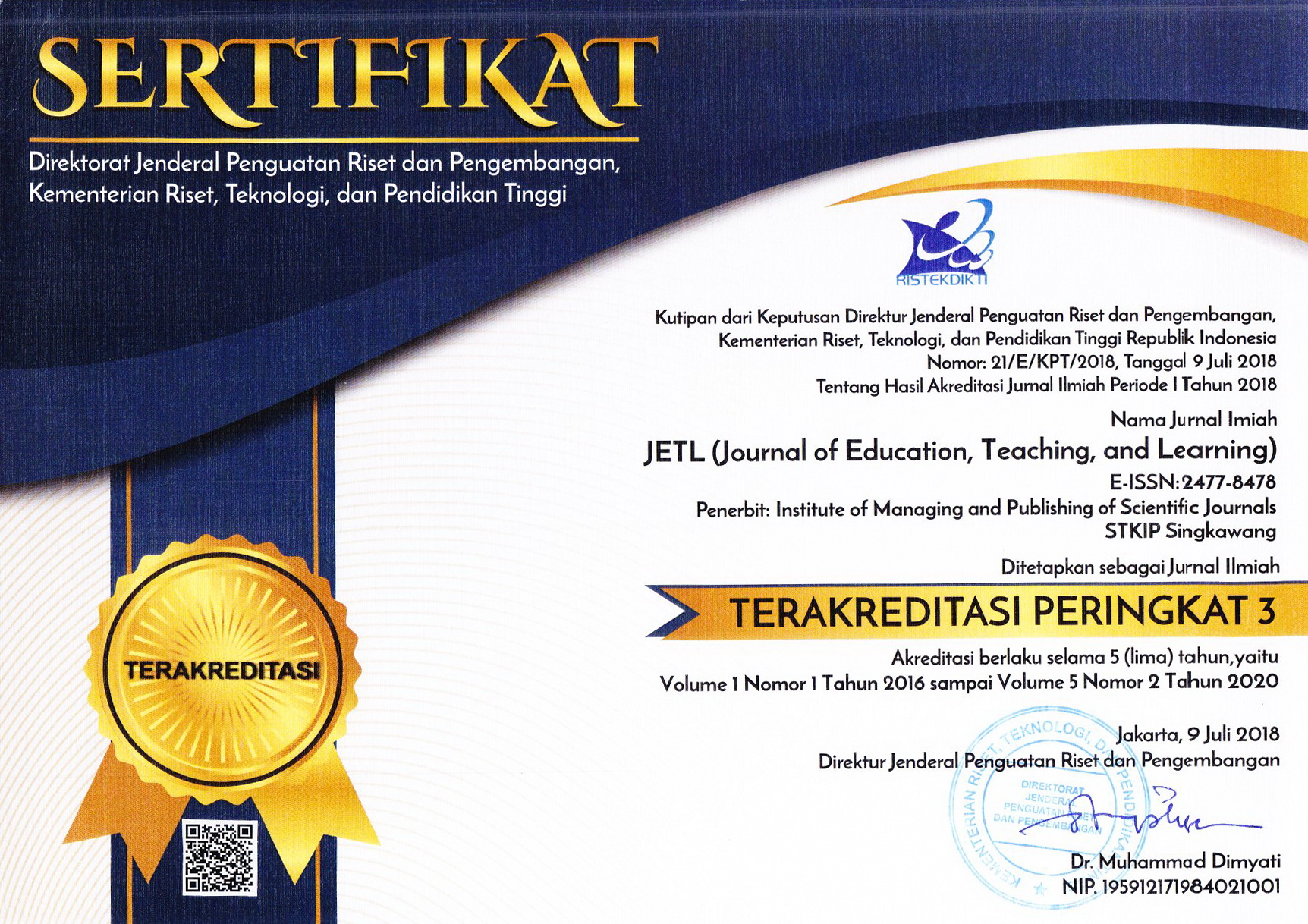


The Influence of Learning Models and Motivation Study On Learning Outcomes Student Class V of Elementary School 106 Pekanbaru
Abstract
Keywords
Full Text:
PDFReferences
Adib, H. (2021). Problematika Penggunaan Gadget dalam Pembelajaran Masa Pandemi Covid-19 (Dampak dan Solusi bagi Kesehatan Siswa. Asatiza: Jurnal Pendidikan, 2(3), 170–179. https://doi.org/10.46963/asatiza.v2i3.391.
Aditama, Z. T. H. (2014). Penerapan model pembelajaran STAD ( Student Team Achievement Division) terhadap hasil belajar ketepatan service bawah Bolavoli. Jurnal Pendidikan Olahraga Dan Kesehatan, 2(1).
Almulla, M. A. (2024). Investigating influencing factors of learning satisfaction in AI ChatGPT for research: University students perspective. Heliyon, 10(11), e32220. https://doi.org/10.1016/j.heliyon.2024.e32220
An, R., Zhang, H., Akbar, A., & Haider, S. A. (2024). Exploring the influence of teacher-student relationships on Chinese language learning through the mediating role of student’s self-efficacy: Foreign language classroom anxiety as a moderator. Acta Psychologica, 251, 104552. https://doi.org/10.1016/j.actpsy.2024.104552
Arief, H. S., & dkk. (2016). Meningkatkan Motivasi Belajar Melalui Pendekatan Problem-Based Learning (PLB. Jurnal Pena Ilmiah, 1(1), 141–150.
Chen, D., Liu, W., & Liu, X. (2024). What drives college students to use AI for L2 learning? Modeling the roles of self-efficacy, anxiety, and attitude based on an extended technology acceptance model. Acta Psychologica, 249, 104442. https://doi.org/10.1016/j.actpsy.2024.104442
Erwansyah, A. A., & dk. (2016). Pengaruh Permainan Lompat Kardus Terhadap Hasil Belajar Lompat Gaya Menggantung Dalam Pembelajaran Pjok. Jurnal Pendidikan Olahraga Dan Kesehatan, 4(2).
Go, C. F. M., Gonzales, F. R. S., Gonzales, M. M. T., Gonzales, S. A. C., Gregorio, A. H., Guerra, M. A. E. G., Guillermo, J.-R. E., Gumapos, N. F. M., Malong-Consolacion, C. P., Chua, R. L. E., & Berdida, D. J. E. (2024). Nursing students’ blended learning satisfaction, self-efficacy, and work readiness: A structural equation modeling study. Teaching and Learning in Nursing, 19(4), e638–e645. https://doi.org/10.1016/j.teln.2024.05.010
Guay, F. (2016). The Virtue Of Culture In Understanding Motivation At School: Commentary On The Special Issue On Culture and Motivation. British Journal of Educational, ology(86), 154–160.
Han, J., Liu, G., Liu, X., Yang, Y., Quan, W., & Chen, Y. (2024). Continue using or gathering dust? A mixed method research on the factors influencing the continuous use intention for an AI-powered adaptive learning system for rural middle school students. Heliyon, 10(12), e33251. https://doi.org/10.1016/j.heliyon.2024.e33251
Handayani, S. N., Sihkabuden, S., & Praherdhiono, H. (2018). Pengembangan multimedia interaktif seni tari Jawa Timur pada mata pelajaran seni budaya kelas VII di SMP Negeri 1 Karangan. Jurnal Kajian Teknologi Pendidikan, 1(1), 63–70.
Huang, S., & Zhang, H. (2024). Gamification acceptance model towards online learning among college students: an empirical study based on mediation and moderation. Asian Education and Development Studies, 13(2), 150–167. https://doi.org/10.1108/AEDS-11-2023-0152
Indahini, R. S., Sulton, S., & Husna, A. (2018). Pengembangan Multimedia Mobile Learning Pada Mata Pelajaran Simulasi Dan Komunikasi Digital Kelas X SMK. Jurnal Kajian Teknologi Pendidikan, 1(2), 141–148.
Kaban, R. H., Anzelina, D., Sinaga, R., & Silaban, P. J. (2021). Pengaruh Model Pembelajaran PAKEM terhadap Hasil Belajar Siswa di Sekolah Dasar. Jurnal Basicedu, 5(1), 102–109.
Konstantinidis, A. (2024). An integrative review of the literature on factors influencing student well-being in the learning environment. International Journal of Educational Research Open, 7, 100384. https://doi.org/10.1016/j.ijedro.2024.100384
Labrague, L. J. (2024). Examining the influence of social support and resilience on academic self-efficacy and learning outcomes in pre-licensure student nurses. Journal of Professional Nursing, 55, 119–124. https://doi.org/10.1016/j.profnurs.2024.09.012
Lahir, S., & dkk. (2017). Peningkatan Prestasi Belajar Melalui Model Pembelajaran yang Tepat Pada Sekolah Dasar Sampai Perguruan Tinggi. Edunomika, 1(1), 1–8.
Li, L., Meng, W., Wang, L., Jiang, Y., Kong, Q., & Shi, Z. (2024). Mental Health Factors and Learning Adaptability Among Nursing Students During the COVID-19 Pandemic: A Structural Equation Modelling Study. Teaching and Learning in Nursing. https://doi.org/10.1016/j.teln.2024.11.017
Lin, Y.-L., & Wang, W.-T. (2024). The influences of virtual-reality- and animation-supported gamified learning processes on students’ learning achievement and behavioral intention in retailing management courses. The International Journal of Management Education, 22(3), 101047. https://doi.org/10.1016/j.ijme.2024.101047
Luo, T., & Derakhshan, A. (2024). Examining the role of classroom climate and teacher-student relationships in EFL students’ perceived learning outcomes: A self-determination theory perspective. Learning and Motivation, 88, 102062. https://doi.org/10.1016/j.lmot.2024.102062
Ly, B., Doeur, B., & nat, S. (2024). Key factors influencing digital learning adoption among cambodian university students: An integrated theoretical approach. Computers in Human Behavior Reports, 15, 100460. https://doi.org/10.1016/j.chbr.2024.100460
Miftahul, H., & Hasbiyati, H. (2018). Upaya Peningkatan Akivitas Dan Hasil Belajar Siswa Melalui Media E-Book Berekstensi Epub Pada Materi Pencemaran Lingkungan Di Smp 01 Islam Jember 2017/2018. Jurnal Educazione : Jurnal Pendidikan, Pembelajaran Dan Bimbingan Dan Konseling, 6(1). http://ejurnal.uij.ac.id/index.php/EDU/article/view/579.
Miranda, E., Aryuni, M., Rahmawati, M. I., Hiererra, S. E., & Dian Sano, A. V. (2024). Machine learning’s model-agnostic interpretability on the prediction of students’ academic performance in video-conference-assisted online learning during the covid-19 pandemic. Computers and Education: Artificial Intelligence, 7, 100312. https://doi.org/10.1016/j.caeai.2024.100312
Pan, F., Zhu, G., Sui, W., & Fu, M. (2024). The effects of peer interaction on learning outcome of college students in digital environment—The chain-mediated role of attitude and self-efficacy. Studies in Educational Evaluation, 83, 101404. https://doi.org/10.1016/j.stueduc.2024.101404
Pan, J., Ishak, N. A., & Qin, Y. (2024). The application of Moore’s online learning interactions model in learning outcomes: The SOR (stimulus-organism-response) paradigm perspective. Heliyon, 10(7), e28505. https://doi.org/10.1016/j.heliyon.2024.e28505
Puspitasari, Y., & Nurhayati, S. (2019). Pengaruh model pembelajaran discovery learning terhadap hasil belajar siswa. Jurnal Pendidikan Dan Kewirausahaan, 7(1), 93–108.
Saragih, L. M., Tanjung, D. S., & Anzelina, D. (2021). Pengaruh Model Pembelajaran Open Ended terhadap Hasil Belajar Siswa pada Pembelajaran Tematik. Jurnal Basicedu, 5(4), 2644–2652.
Satriawan, A. (2014). Implementasi Model pembelajaran Kooperatif Tipe Student Teams Achievement Division (STAD) Dalam Meningkatkan Hasil Belajar Bermain Sepak bola Siswa Kelas VII. Jurnal Ilmu Keolahragaan, 19(2), 157–62. https://jurnal.unimed.ac.id/2012/index.php/JIK/
Setyo, N. A., & Wahjoedi, I. M. S. (2019). Pengaruh Model Pembelajaran Inquiry Terhadap Hasil Belajar Sepakbola Pada Siswa Kelas Viismp Negeri 3 Sukasada. Jurnal Pendidikan Jasmani Olahraga Dan Kesehatan, 7(3).
Tarhini, A., AlHinai, M., Al-Busaidi, A. S., Govindaluri, S. M., & Shaqsi, J. Al. (2024). What drives the adoption of mobile learning services among college students: An application of SEM-neural network modeling. International Journal of Information Management Data Insights, 4(1), 100235. https://doi.org/10.1016/j.jjimei.2024.100235
Xiao, Y., & Hew, K. F. (2024). Personalized gamification versus one-size-fits-all gamification in fully online learning: Effects on student motivational, behavioral and cognitive outcomes. Learning and Individual Differences, 113, 102470. https://doi.org/10.1016/j.lindif.2024.102470
Zhang, F. (2024). Effects of game-based learning on academic outcomes: A study of technology acceptance and self-regulation in college students. Heliyon, 10(16), e36249. https://doi.org/10.1016/j.heliyon.2024.e36249
DOI: http://dx.doi.org/10.26737/jetl.v10i1.6687
Refbacks
- There are currently no refbacks.


This work is licensed under a Creative Commons Attribution-NonCommercial 4.0 International License.
Published by:
Institute of Managing and Publishing of Scientific Journals STKIP Singkawang
Sekolah Tinggi Keguruan dan Ilmu Pendidikan (STKIP) Singkawang
Address : STKIP Singkawang, Jalan STKIP - Kelurahan Naram Singkawang, Kalimantan Barat, INDONESIA, 79251
No. Telp. : +62562 420 0344
No. Fax. : +62562 420 0584
JETL (Journal of Education, Teaching, and Learning)
e-ISSN : 2477-8478
p-ISSN : 2477-5924

Editor in Chief Contact: [email protected] / Wa: +6285245101122
Publisher Contact: [email protected] / Wa: +6281217024040/+6285750845033
Management Tools



JETL Indexed by: