Email this article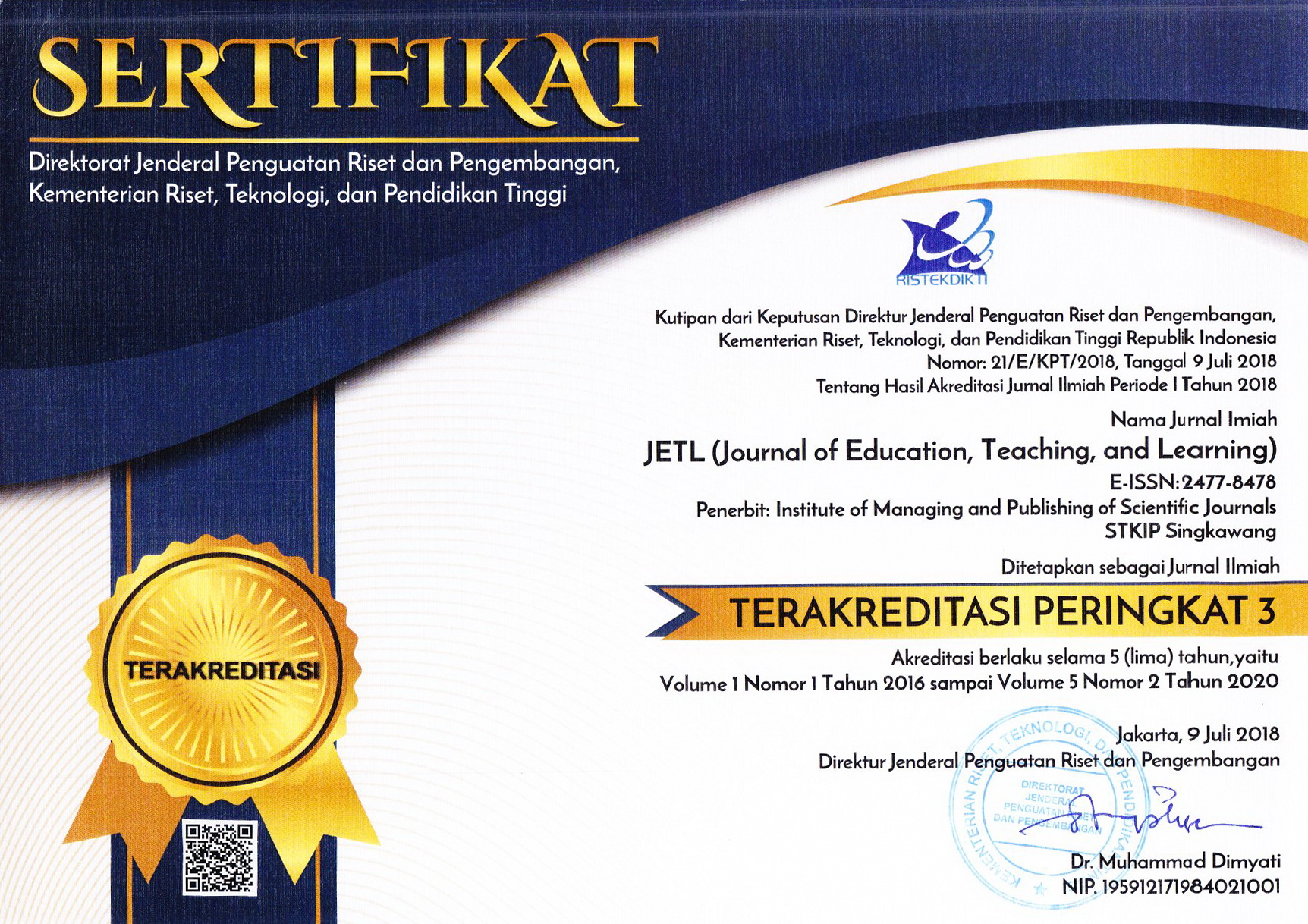


Transformation of Creative Thinking Skills and Environmental Concern with PBSL Learning in Geography Class
Abstract
The ability to think creatively is an important skill that must be possessed by 21st century students, while an attitude of caring for the environment is an important foundation in maintaining the balance of nature. This study aims to: (1) measure the influence of Project Based SCAMPER Learning (PBSL) on students' creative thinking skills, and (2) evaluate the influence of PBSL on environmental care attitudes. This research was conducted at SMAN 1 Ngadiluwih with a sample of students in class X, consisting of 36 students in the experimental class and 36 students in the control class. Data were collected using creative thinking skills tests and environmental care questionnaires, and analyzed using statistical tests, including normality, homogeneity, and two-way ANOVA tests. The results show that PBSL has a significant impact on students' creative thinking skills, especially on the originality indicator, which has experienced the greatest improvement. Students are able to produce innovative new ideas in the field of education.
Keywords
Full Text:
PDFReferences
Ajzen, I. (2002). Perceived behavioral control, self-efficacy, locus of control, and the theory of planned behavior. Journal of Applied Social Psychology, 32(4), 665–683. https://doi.org/10.1111/j.1559-1816.2002.tb00236.x
Amin, S., Utaya, S., Bachri, S., Sumarmi, & Susilo, S. (2020). Effect of problem-based learning on critical thinking skills and environmental attitude. Journal for the Education of Gifted Young Scientists, 8(2), 743–755. https://doi.org/10.17478/jegys.650344
Andrews, D., & Townsend, B. (2017). A tale from the tropics: Education for sustainability and the value of project-Based learning. Proceedings of the 19th International Conference on Engineering and Product Design Education: Building Community: Design Education for a Sustainable Future, E and PDE 2017, September, 340–345.
Arikunto, S. (2021). dasar-dasar Evaluasi Pendidikan. Bumi Aksara.
Billah, A., Khasanah, U., & Widoretno, S. (2019). Empowering Higher-Order Thinking through Project-Based. 020011.
Chen, S Y, Lai, C. F., Lai, Y. H., & Su, Y. S. (2019). Effect of project-based learning on development of students’ creative thinking. The International Journal …. https://doi.org/10.1177/0020720919846808
Chen, Shih Yeh, Lai, C. F., Lai, Y. H., & Su, Y. S. (2022). Effect of project-based learning on development of students’ creative thinking. International Journal of Electrical Engineering and Education, 59(3), 232–250. https://doi.org/10.1177/0020720919846808
Chien, Y. C., Liu, M. C., & Wu, T. T. (2020). Discussion-record-based prediction model for creativity education using clustering methods. Thinking Skills and Creativity. https://www.sciencedirect.com/science/article/pii/S1871187119303360
Denuga, D. D., & Nkengbeza, D. (2022). Pre-Service Teachers Experience in Project-Based Learning Approach: A Case Study of Two Campuses of the University of A (UNA). Open Journal of Social Sciences, 10(04), 121–132. https://doi.org/10.4236/jss.2022.104009
Efendi, D., Sumarmi, S., & Utomo, D. H. (2020). The effect of PjBL plus 4Cs learning model on critical thinking skills. Journal for the Education of Gifted Young Scientists, 8(4), 1509–1521. https://doi.org/10.17478/jegys.768134
Farid Fakhry Tharwa, F. (2019). Using the SCAMPER Model to DevelopTranslation Skills for Major Students in the Faculty of Education, Majmaah University, Saudi Arabia. Arab World English Journal For Translation and Literary Studies, 3(2), 91–113. https://doi.org/10.24093/awejtls/vol3no2.9
Fatchan, A., Soekamto, H., Sumarmi, ., & Utaya, S. (2016). Effect of Learning “Outdoor Study” Ability to Communicate in Writing and Social-Geography Student Learning Outcomes at “Mataraman” East Java-The Republic of Indonesia*. Mediterranean Journal of Social Sciences, 7(3), 429–435. https://doi.org/10.5901/mjss.2016.v7n3p429
Guo, P., Saab, N., Post, L. S., & Admiraal, W. (2020). A review of project-based learning in higher education: Student outcomes and measures. International Journal of Educational Research, 102(April), 101586. https://doi.org/10.1016/j.ijer.2020.101586
Halek, D. H., Sumarmi, Budijanto, & Utomo, D. H. (2021). Examination Improving Character towards Environment Care Through Their Creativity and Innovation at School (A Case Study at the Senior High School 3 Ternate City)*. Eurasian Journal of Educational Research, 96(96), 82–101. https://doi.org/10.14689/ejer.2021.96.6
Hawa, N. N., Zakaria, S. Z. S., Razman, M. R., & Majid, N. A. (2021). Geography education for promoting sustainability in Indonesia. Sustainability (Switzerland), 13(8), 1–15. https://doi.org/10.3390/su13084340
Hwang, R. H., Hsiung, P. A., Chen, Y. J., & Lai, C. F. (2017). Innovative project-based learning. International Symposium on …. https://doi.org/10.1007/978-3-319-71084-6_21
Ichsan, I. Z., Sigit, D. V., Miarsyah, M., Ali, A., Arif, W. P., & Prayitno, T. A. (2019). HOTS-AEP: Higher order thinking skills from elementary to master students in environmental learning. European Journal of Educational Research, 8(4), 935–942. https://doi.org/10.12973/eu-jer.8.4.935
Kokotsaki, D., Menzies, V., & Wiggins, A. (2016). Project-based learning: A review of the literature. Improving Schools, 19(3), 267–277. https://doi.org/10.1177/1365480216659733
Kolmos, A., Holgaard, J. E., & Clausen, N. R. (2020). Progression of student self-assessed learning outcomes in systemic PBL. European Journal of Engineering Education, 0(0), 1–23. https://doi.org/10.1080/03043797.2020.1789070
Kristina Kasi, Sumarmi, and K. A. (2018). Pengaruh Model Pembelajaran Service Learning Terhadap Sikap Peduli Lingkungan Dan Kemampuan Menulis Karya Ilmiah Siswa SMA. Jurnal Pendidikan:Teori, Penelitian, Dan Pengembangan, 4(3), 437–440.
Landau, B., Smith, L. B., & Jones, S. S. (1988). The importance of shape in early lexical learning. Cognitive Development, 3(3), 299–321. https://doi.org/10.1016/0885-2014(88)90014-7
Listiqowati, I., Budijanto, Sumarmi, & Ruja, I. N. (2022). The Impact of Project-Based Flipped Classroom (PjBFC) on Critical Thinking Skills. International Journal of Instruction, 15(3), 853–868. https://doi.org/10.29333/iji.2022.15346a
Luana, P., Syaibana, D., Putra, A. K., & Suharto, Y. (2022). Collaborative Creativity Learning : Analyzing Scientific Creativity and Problem Solving Watershed Conservation Studies in Learning (Vol. 1). Atlantis Press SARL. https://doi.org/10.2991/978-2-494069-63-3
Meliyev Muzaffar Saidakbarovich. (2022). FORMATION OF ECOLOGICAL CULTURE IN THE TEACHING OF FLORA AND FAUNA. 3(12), 115–118.
Milfont, T. L., & Duckitt, J. (2010). The environmental attitudes inventory: A valid and reliable measure to assess the structure of environmental attitudes. Journal of Environmental Psychology, 30(1), 80–94. https://doi.org/10.1016/j.jenvp.2009.09.001
Nagel, P. (2008). The essential skill for 21st century. Social Education, 72(7), 354–358.
Nation, M. L. (2008). Project-based learning for sustainable development. Journal of Geography, 107(3), 102–111. https://doi.org/10.1080/00221340802470685
Özyaprak, M. (2016). The effectiveness of SCAMPER technique on creative thinking skills. Journal for the Education of Gifted Young Scientists, 4(1), 31–40. https://doi.org/10.17478/JEGYS.2016116348
Purwanto. (2009). Evaluasi Hasil Belajar. Pustaka Pelajar.
Risnani, L. Y. (2019). Teknik SCAMPER : Stimulasi Kreativitas Mahasiswa Calon Guru Biologi pada Aktivitas Laboratorium SCAMPER Technique : Stimulation of Student Creativity for Pre-service Biology Teacher in Laboratory Activities. BIOEDUKASI: Jurnal Pendidikan Biologi, 12(1), 35–40.
Rizal, S. (2022). CREATIVE THINKING AND PROCESS SCIENCE SKILL: SELF-ORGANIZED LEARNING ENVIRONMENT ON WATERSHED CONSERVATION MATERIAL. Jurnal Pendidikan IPA Indonesia SELF-ORGANIZED LEARNING ENVIRONMENT ON, 11(4), 578–587. https://doi.org/10.15294/jpii.v11i4.39571
Rosenfeld, Sherman; Benhur, Y. (2001). Project-Based Learning (PBL) in Science and Technology: A Case Study of Professional Development. Journal of Action Research and Professional Development, II(1), 460–480.
Sari, Y. I., Sumarmi, Utomo, D. H., & Astina, I. K. (2021). The Effect of Problem Based Learning on Problem Solving and Scientific Writing Skills. International Journal of Instruction, 14(2), 11–26. https://doi.org/10.29333/iji.2021.1422a
Scoffham, S. (2003). Thinking creatively. Primary Geographer, 50, pp. 4–6. 0956-277x
Selçuk, G. S. (2010). The effects of problem-based learning on pre-service teachers’ achievement, approaches and attitudes towards learning physics. International Journal of Physical Sciences, 5(6), 711–723.
Stoltman, J. P., Lidstone, J., & Kidman, G. (2017). 2016 International Charter on Geographical Education The Purpose of the Charter on Geographical Education. 1–8.
Suh, S. (2019). A Study on the Application of SCAMPER Techniques for the Development of Fashion Design -Focusing on the Development of the SCAMPER Questions-. Journal of Fashion Business, 23(3), 1–9.
Sukaesih, S. 2022. Pengaruh Project Based Learning Dilengkapi Mind Mapping (PJBL-MM) Dan Gender Terhadap Pemahaman Hakikat Sains, Kesadaran Metakognisi, Keterampilan Berpikir Kreatif Dan Sikap Lingkungan Mahasiswa. Dissertation. Malang: Universitas Negeri Malang.
Sumarmi. (2012). Model-model Pembelajaran Geografi. In Aditya Media Publishing.
Sumarmi, Aliman, M., & Mutia, T. (2021). The Effect Of Digital Eco-Learning In Student Worksheet Flipbook To Environmental Project Literacy And Pedagogic Competency. Journal of Technology and Science Education, 11(2), 357–370. https://doi.org/10.3926/jotse.1175
TORRANCE, E. P. (1972). Predictive Validity of the Torrance Tests of Creative Thinking. The Journal of Creative Behavior, 6(4), 236–262. https://doi.org/10.1002/j.2162-6057.1972.tb00936.x
Usher, J. (2021). Powerful primary geography: a toolkit for 21st century Learning. Irish Educational Studies, 40(4), 689–691. https://doi.org/10.1080/03323315.2021.1899032
Van Giesen, R. I., Fischer, A. R. H., Van Dijk, H., & Van Trijp, H. C. M. (2015). Affect and cognition in attitude formation toward familiar and unfamiliar attitude objects. PLoS ONE, 10(10), 1–14. https://doi.org/10.1371/journal.pone.0141790
Wibowo, N. A., Sumarmi, S., Utaya, S., & Bachri, S. (2023). Students ’ Environmental Care Attitude : A Study at Adiwiyata Public High School Based on the New Ecological Paradigm ( NEP ).
Wu, T. T., & Wu, Y. T. (2020). Applying project-based learning and SCAMPER teaching strategies in engineering education to explore the influence of creativity on cognition, personal motivation, and personality traits. Thinking Skills and Creativity, 35, 100631. https://doi.org/10.1016/j.tsc.2020.100631
Yli-Panula, E., Jeronen, E., & Lemmetty, P. (2020). Teaching and Learning Methods in Geography Promoting Sustainability. Education Sciences, 10(1).
DOI: http://dx.doi.org/10.26737/jetl.v10i1.6083
Refbacks
- There are currently no refbacks.


This work is licensed under a Creative Commons Attribution-NonCommercial 4.0 International License.
Published by:
Institute of Managing and Publishing of Scientific Journals STKIP Singkawang
Sekolah Tinggi Keguruan dan Ilmu Pendidikan (STKIP) Singkawang
Address : STKIP Singkawang, Jalan STKIP - Kelurahan Naram Singkawang, Kalimantan Barat, INDONESIA, 79251
No. Telp. : +62562 420 0344
No. Fax. : +62562 420 0584
JETL (Journal of Education, Teaching, and Learning)
e-ISSN : 2477-8478
p-ISSN : 2477-5924

Editor in Chief Contact: [email protected] / Wa: +6285245101122
Publisher Contact: [email protected] / Wa: +6281217024040/+6285750845033
Management Tools



JETL Indexed by: