Email this article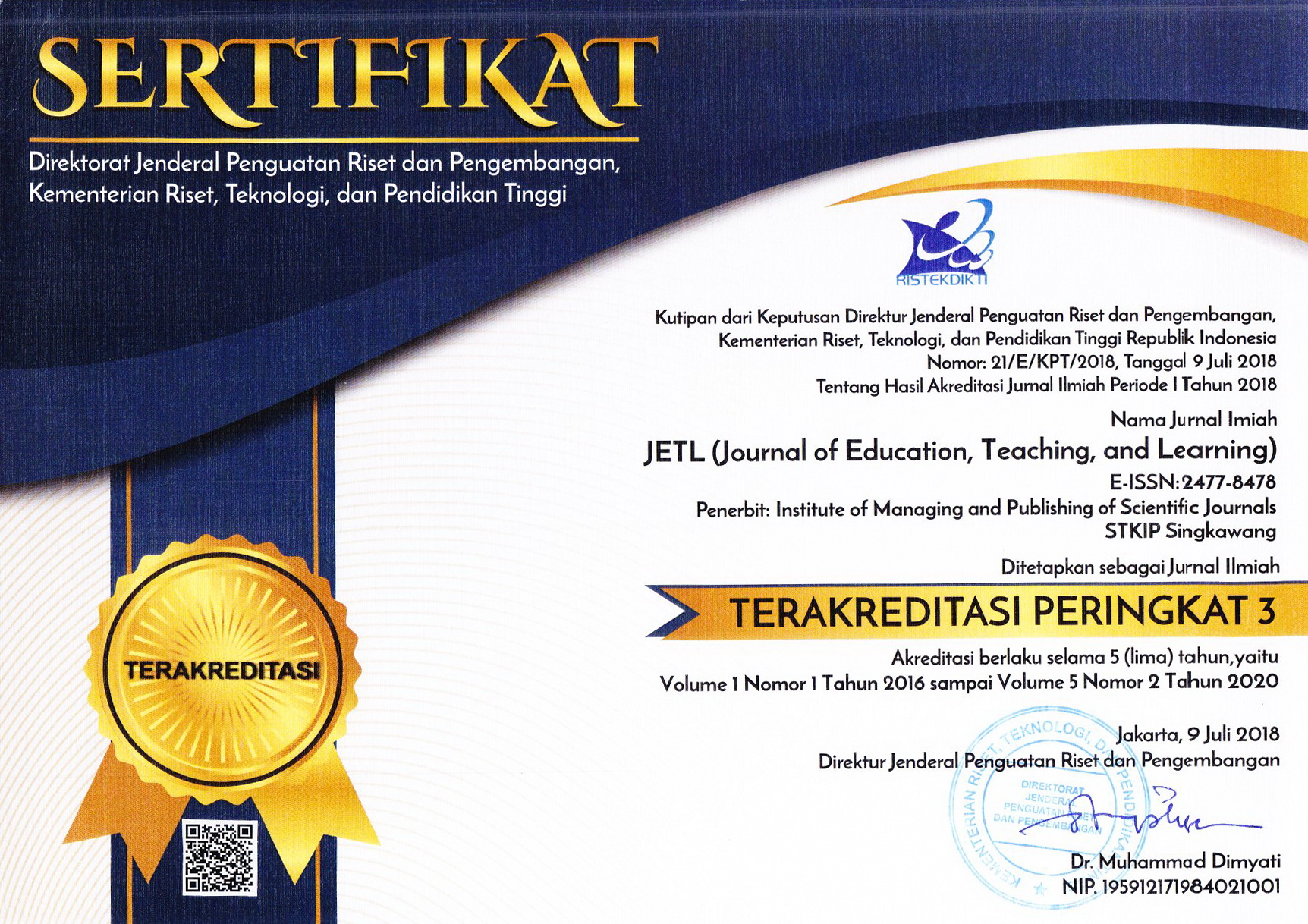


Analysis of Teacher and Student Readiness in Implementing Coding-Based Learning and Artificial Intelligence at Vocational High School 1 Mempawah Timur
Abstract
Keywords
Full Text:
PDFReferences
Bond, M., Buntins, K., Bedenlier, S., Zawacki-Richter, O., & Kerres, M. (2021). Mapping research in student engagement and educational technology in higher education: A systematic evidence map. International Journal of Educational Technology in Higher Education, 18(1), 1–30. doi:10.1186/s41239-021-00249-1
Chiu, T. K. F. (2021). Digital support for student engagement in blended learning based on self-determination theory. Computers in Human Behavior, 124, 106909. doi:10.1016/j.chb.2021.106909
Crompton, H., & Burke, D. (2023). Artificial intelligence in higher education: The state of the field. International Journal of Educational Technology in Higher Education, 20(1), 1–22. doi:10.1186/s41239-023-00392-3
Instefjord, E. J., & Munthe, E. (2017). Educating digitally competent teachers: A study of integration of professional digital competence in teacher education. Teaching and Teacher Education, 67, 37–45. doi:10.1016/j.tate.2017.05.016
Kemendikbud. (2022). Policy on strengthening technology- and coding-based learning in educational units. Jakarta, Indonesia: Ministry of Education, Culture, Research, and Technology. Retrieved from https://www.kemdikbud.go.id/
Lai, J. W. M., & Bower, M. (2019). How is the use of technology in education evaluated? A systematic review. Computers & Education, 133, 27–42. doi:10.1016/j.compedu.2019.01.010
Mulyasa, E. (2017). Becoming a professional teacher: Creating creative and enjoyable learning. Bandung, Indonesia: Remaja Rosdakarya.
OECD. (2019). OECD learning compass 2030. Paris, France: OECD Publishing. Retrieved from https://www.oecd.org/education/2030-project/
Ouyang, F., & Jiao, P. (2021). Artificial intelligence in education: The three paradigms. Computers and Education: Artificial Intelligence, 2, 100020. doi:10.1016/j.caeai.2021.100020
Shute, V. J., Sun, C., & Asbell-Clarke, J. (2017). Demystifying computational thinking. Educational Research Review, 22, 142–158. doi:10.1016/j.edurev.2017.09.003
Sugiyono. (2022). Educational research methods: Quantitative, qualitative, and R&D approaches. Bandung, Indonesia: Alfabeta.
Tikva, C., & Tambouris, E. (2021). A systematic mapping study on teaching and learning computational thinking through programming in higher education. Thinking Skills and Creativity, 41, 100849. doi:10.1016/j.tsc.2021.100849
Tondeur, J., van Braak, J., Siddiq, F., & Scherer, R. (2017). Time for a new approach to prepare future teachers for educational technology use: Its meaning and measurement. Computers & Education, 94, 134–150. doi:10.1016/j.compedu.2015.11.009
DOI: http://dx.doi.org/10.26737/jetl.v10i2.9000
Refbacks
- There are currently no refbacks.


This work is licensed under a Creative Commons Attribution-NonCommercial 4.0 International License.
Published by:
Institute of Managing and Publishing of Scientific Journals STKIP Singkawang
Sekolah Tinggi Keguruan dan Ilmu Pendidikan (STKIP) Singkawang
Address : STKIP Singkawang, Jalan STKIP - Kelurahan Naram Singkawang, Kalimantan Barat, INDONESIA, 79251
No. Telp. : +62562 420 0344
No. Fax. : +62562 420 0584
JETL (Journal of Education, Teaching, and Learning)
e-ISSN : 2477-8478
p-ISSN : 2477-5924

Editor in Chief Contact: [email protected] / Wa: +6285245101122
Publisher Contact: [email protected] / Wa: +6281217024040/+6285750845033
Management Tools



JETL Indexed by: