Email this article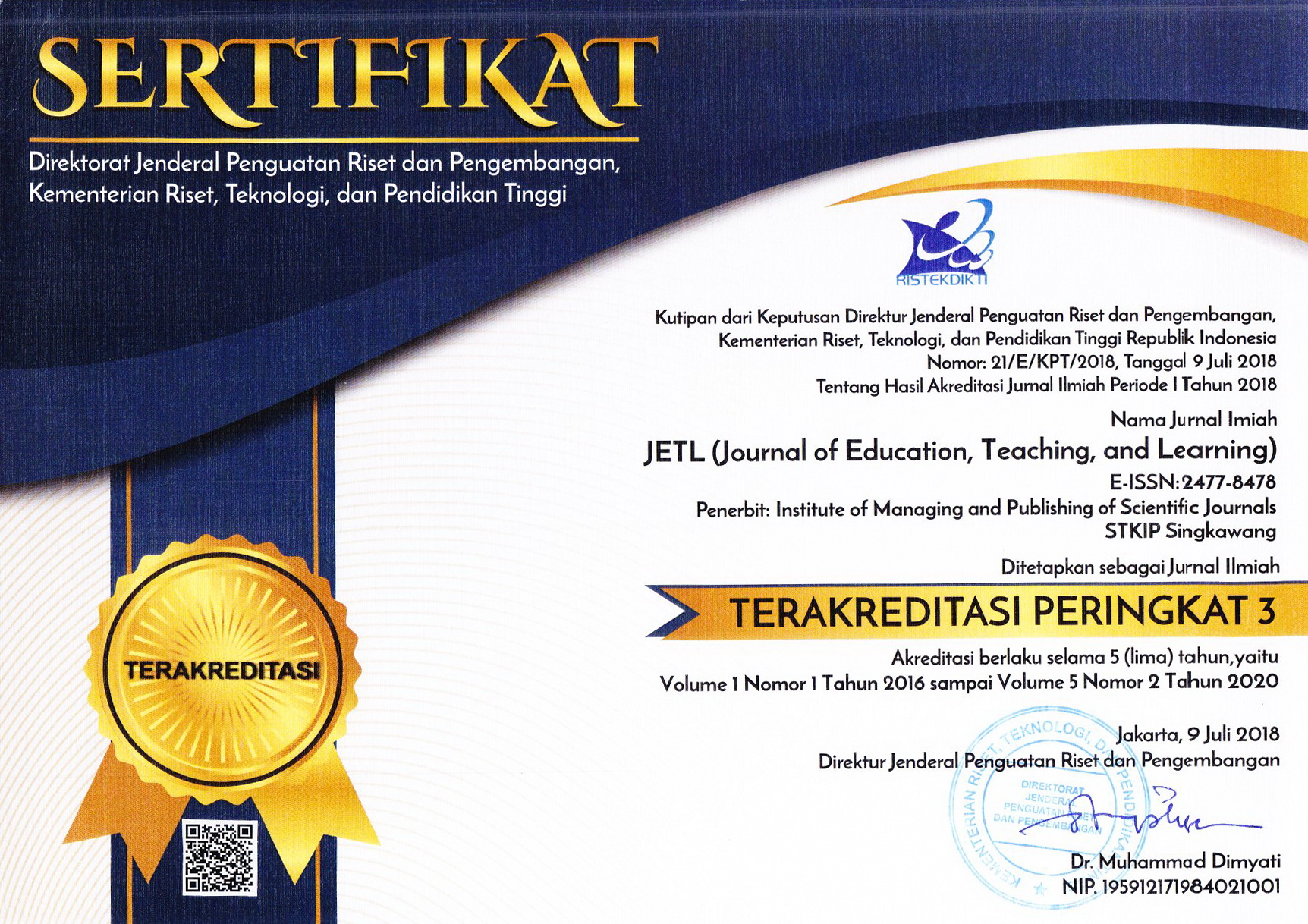


Improving Problem-Solving Ability and Character in Subject-Specific Pedagogic with Heuristic Strategy
Abstract
Keywords
Full Text:
PDFReferences
Bacher, J.M. (1991). Subject Specific Pedagogy: Are we ready to change our vision of teaching. Pennsylvania: Edinboro University of Pennsylvania.
Boonen, A. J. H., van Der Schoot, M., van Wesel, F., de Vries, M. H., & Jolles, J. (2013). What underlies successful word problem solving? A path analysis in sixth grade students. Contemporary Educational Psychology, 38(3), 271–279.
Chavez, J.A. (2007). Enlivening problems with heuristics through learning activities and problem solving. Learning Science and Mathematics, 2, 1-8.
Corte, E. de, Greer, B., & Verschaffel, L. (1996). Psychology of Mathematics Teaching and Learning, in D.C Berliner & R.C. Calfee (Eds.), Hand Book of Educational Psychology, 491-549.
Darma, Y., & Firdaus, M. (2016). Mengembangkan Kemampuan Pemecahan Masalah Melalui Pembelajaran Strategi Heuristik Dengan Pendekatan Metakognitif Ditinjau Dari Kemandirian Belajar Mahasiswa Calon Guru Matematika. JIPM (Jurnal Ilmiah Pendidikan Matematika), 5(1), 1-10.
De Lange, J. (2004). Mathematical Literacy for Living from OECD-PISA Perspective. Paris: OECD-PISA.
Ginsburg, H. P., Labrecque, R., Carpenter, K., & Pagar, D. (2015). New possibilities for early mathematics education: Cognitive guidelines for designing high-quality software to promote young children’s meaningful mathematics learning. In R. Cohen Kadosh & A. Dowker (Eds.), The Oxford Handbook Of Numerical Cognition, 1055–1098.
Hoon, T.S., Singh, P., Han, C.T., Kee, K.L. (2013). Heuristic approach experience in solving mathematical problems. Educational Research, 4(8), 607-611.
Hudoyo dan Sutawijaya. (1998). Pendidikan Matematika I. Jakarta: Dirjen Dikti Depdiknas.
Kemdiknas. (2010). Pengembangan Pendidikan Budaya dan Karakter Bangsa. Jakarta: Puskur-Balitbang.
Kilpatrick, J.,Swafford, J.,& Findell, B. (2001). Adding It Up: Helping Children Learn Mathematics. Washington DC: National Academy Press.
Koichu,B., Berman, A., And Moore, M. (2014).The effect of promoting heuristic literacy on the mathematical aptitude of middle-school students. International Journal of mathematical Education in Science and Technology. http://www.tandfonline.com/loi/tmes20
Kusdinar, U. (2016). Use Of Heuristic Strategies To Increase The Ability Of Mathematical Problem Solving. Proceeding-The Progressive and Fun Education Seminar, 84-89. Surakarta: UMS.
Lester, F., Garofalo, J. & Kroll, D. (1989). The Role of Metacognition in Mathematical Problem Solving: A Study of Two Grade Seven Classes (Final Report to The National Science Foundation, NSF Project No. MDR 85-50346). Blomington: Indiana University, Mathematics Education Development Center.
Marsound, D. (2005). Improving Math Education in Elementary School : A Short Book for Teachers. Oregon : University of Oregon. [online]. Tersedia http://darkwing.uoregon.edu/.../ElMath.pdf
Peraturan Pemerintah Nomor 19 Tahun 2005, tentang Standar Nasional Pendidikan. Jakarta: Depdiknas.
Purnamasari, Pawestri, D. (2015). Analisis Kmampuan Pemecahan Maalah Matematika Siswa Kelas XI SMK Muhammadiyah 1 Patuk Pada Pokok Bahasan Peluang. Yogyakarta: Jurnal UNY.
Reys, Robert E., Marilyn N. Suydam, Mary Montgomery Lindquist. (1998). Helping Children Learn Mathematic (5th ed). Needham Hwight : Allyn & Bacon.
Rokhman, F., Hum, M., Syaifudin, A., Yuliati. (2014). Character Education For Golden Generation 2045 (National Character Building for Indonesian Golden Years). Procedia - Social and Behavioral Sciences, 141, 1161–1165.
Schoenfeld, A. (1992). Learning to Think Mathematically: Problem Solving. Metacognition, and sense Making in Mathematics. In D.A. grows (Ed.), Handbook of Research on Mathematics Teaching and Learning, 334-370.
Schoenfeld, Alan H. (1980). Heuristik in the Classroom, dalam Krulik, S. dan Reys, Robert, E. (Eds). Problem Solving in School Mathematic. Virginia: NCTM.
Sfard, A. (2012). Introduction: Developing mathematical discourse-some insights from communicational research. International Journal of Educational Research, 51-52, 1–9.
Shadiq, F. (2009). Apa dan Mengapa Matematika Begitu Penting?. Yogyakarta: Departemen Pendidikan Nasional.
Suherman, E. (2001). Strategi Pembelajaran Matematika Kontemporer. Bandung: JICA.
Superfine, C., A. (2008). Planning for Mathematics Instructions: A Model of Experienced Teachers’ Planning Processes in the Context of a Reform Mathematics Curriculum. The Mathematics Educator, 18(2), 11- 22.
Ülger, M., Yiğittir, S., Ercan, O. (2014). Secondary School Teachers’ Beliefs On Character Education Competency. Procedia-Social and Behavioral Sciences, 131, 442 – 449.
Verschaffel, L., De Corte, E., Lasure, S., Van Vaerenbergh, G., Bogaerts, H., & Ratinck, E. (1999). Learning to solve mathematical application problems: A design experiment with fifth graders. Mathematical Thinking and Learning, 1, 195–229.
DOI: http://dx.doi.org/10.26737/jetl.v4i2.886
Refbacks
- There are currently no refbacks.


This work is licensed under a Creative Commons Attribution-NonCommercial 4.0 International License.
Published by:
Institute of Managing and Publishing of Scientific Journals STKIP Singkawang
Sekolah Tinggi Keguruan dan Ilmu Pendidikan (STKIP) Singkawang
Address : STKIP Singkawang, Jalan STKIP - Kelurahan Naram Singkawang, Kalimantan Barat, INDONESIA, 79251
No. Telp. : +62562 420 0344
No. Fax. : +62562 420 0584
JETL (Journal of Education, Teaching, and Learning)
e-ISSN : 2477-8478
p-ISSN : 2477-5924

Editor in Chief Contact: [email protected] / Wa: +6285245101122
Publisher Contact: [email protected] / Wa: +6281217024040/+6285750845033
Management Tools



JETL Indexed by: