Email this article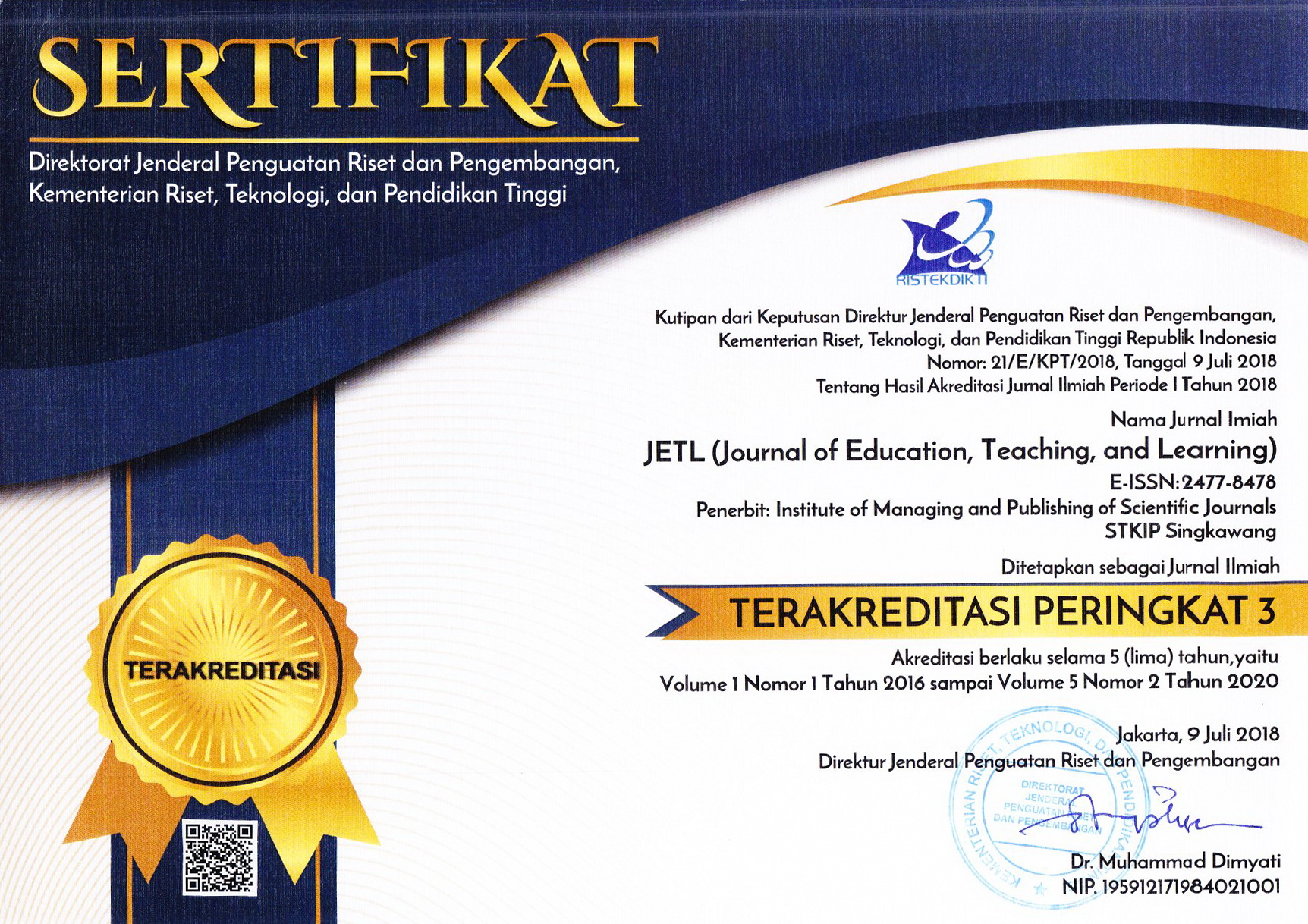


The Influence of the Problem Based Learning Model on Student Activity and Learning Outcomes in Business Economics Elements
Abstract
Keywords
Full Text:
PDFReferences
Amerstorfer, C. M., & Freiin von Münster-Kistner, C. (2021). Student perceptions of academic engagement and student-teacher relationships in problem-based learning. Frontiers in Psychology, 12, 713057.
Aslam, L. K., Suparji, S., & Rijanto, T. (2021). The effect of problem based learning model on learning outcomes in the vocational high school students. International Journal for Educational and Vocational Studies, 3(4), 264–267.
Burgess, A., van Diggele, C., Roberts, C., & Mellis, C. (2020). Team-based learning: design, facilitation and participation. BMC Medical Education, 20(Suppl 2), 461.
Chen, C., Hung, H., & Yeh, H. (2021). Virtual reality in problem‐based learning contexts: Effects on the problem‐solving performance, vocabulary acquisition and motivation of English language learners. Journal of Computer Assisted Learning, 37(3), 851–860.
Dahalan, F., Alias, N., & Shaharom, M. S. N. (2024). Gamification and game based learning for vocational education and training: A systematic literature review. Education and Information Technologies, 29(2), 1279–1317.
Distyasa, M. J. E., Winanti, E. T., Buditjahjanto, I. G. P. A., & Rijanto, T. (2021). The effect of project-based blended learning (PJB2L) learning model on students learning outcomes. International Journal for Educational and Vocational Studies, 3(4), 268–274.
Ghani, A. S. A., Rahim, A. F. A., Yusoff, M. S. B., & Hadie, S. N. H. (2021). Effective learning behavior in problem-based learning: a scoping review. Medical Science Educator, 31(3), 1199–1211.
Hursen, C. (2021). The effect of problem-based learning method supported by web 2.0 tools on academic achievement and critical thinking skills in teacher education. Technology, Knowledge and Learning, 26(3), 515–533.
Mann, L., Chang, R., Chandrasekaran, S., Coddington, A., Daniel, S., Cook, E., Crossin, E., Cosson, B., Turner, J., & Mazzurco, A. (2021). From problem-based learning to practice-based education: A framework for shaping future engineers. European Journal of Engineering Education, 46(1), 27–47.
Mutohhari, F., Sutiman, S., Nurtanto, M., Kholifah, N., & Samsudin, A. (2021). Difficulties in Implementing 21st Century Skills Competence in Vocational Education Learning. International Journal of Evaluation and Research in Education, 10(4), 1229–1236.
Numonjonov, S. D. u. (2020). Innovative methods of professional training. ISJ Theoretical & Applied Science, 1(81), 747–750.
Nurkhin, A., & Pramusinto, H. (2020). Problem-Based Learning Strategy: Its Impact on Students’ Critical and Creative Thinking Skills. European Journal of Educational Research, 9(3), 1141–1150.
Nurtanto, M., Fawaid, M., & Sofyan, H. (2020). Problem based learning (PBL) in Industry 4.0: Improving learning quality through character-based literacy learning and life career skill (LL-LCS). Journal of Physics: Conference Series, 1573(1), 12006.
Rabiman, R., Nurtanto, M., & Kholifah, N. (2020). Design and Development E-Learning System by Learning Management System (LMS) in Vocational Education. Online Submission, 9(1), 1059–1063.
Rafiq, A. A., Triyono, M. B., & Djatmiko, I. W. (2023). The integration of inquiry and problem-based learning and its impact on increasing the vocational student involvement. International Journal of Instruction, 16(1), 659–684.
Saldo, I. J. P., & Walag, A. M. P. (2020). Utilizing problem-based and project-based learning in developing students’ communication and collaboration skills in physics. American Journal of Educational Research, 8(5), 232–237.
Smith, G., Ichda, M. A., Alfan, M., & Kuncoro, T. (2023). Literacy studies: Implementation of problem-based learning models to improve critical thinking skills in elementary school students. KnE Social Sciences, 222–233.
Yanto, D. T. P., Kabatiah, M., Zaswita, H., Giatman, G., & Effendi, H. (2022). Development of Virtual Learning using Problem-Based Learning Models for Vocational Education Students. ELINVO (Electronics, Informatics, and Vocational Education), 7(2), 163–172.
Zhao, W., He, L., Deng, W., Zhu, J., Su, A., & Zhang, Y. (2020). The effectiveness of the combined problem-based learning (PBL) and case-based learning (CBL) teaching method in the clinical practical teaching of thyroid disease. BMC Medical Education, 20(1), 381.
DOI: http://dx.doi.org/10.26737/jetl.v10i2.7693
Refbacks
- There are currently no refbacks.


This work is licensed under a Creative Commons Attribution-NonCommercial 4.0 International License.
Published by:
Institute of Managing and Publishing of Scientific Journals STKIP Singkawang
Sekolah Tinggi Keguruan dan Ilmu Pendidikan (STKIP) Singkawang
Address : STKIP Singkawang, Jalan STKIP - Kelurahan Naram Singkawang, Kalimantan Barat, INDONESIA, 79251
No. Telp. : +62562 420 0344
No. Fax. : +62562 420 0584
JETL (Journal of Education, Teaching, and Learning)
e-ISSN : 2477-8478
p-ISSN : 2477-5924

Editor in Chief Contact: [email protected] / Wa: +6285245101122
Publisher Contact: [email protected] / Wa: +6281217024040/+6285750845033
Management Tools



JETL Indexed by: