Email this article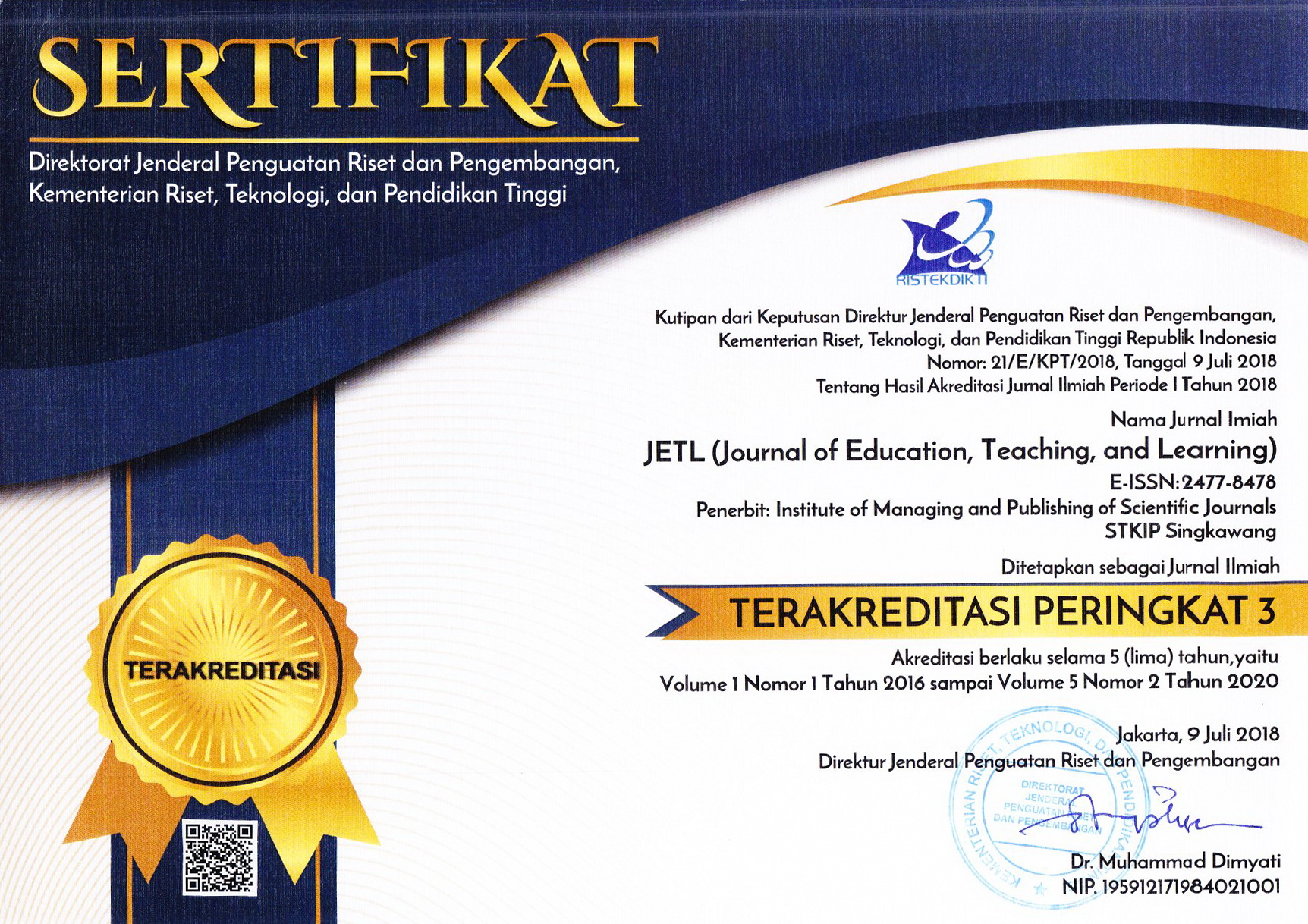


Impact Of Play-Based Instruction And Jigsaw On Learning Motivation And Physical Fitness In Smk Tanjungpinang
Abstract
Keywords
Full Text:
PDFReferences
Abuhamdeh, S., & Csikszentmihalyi, M. (2012). The importance of challenge for the enjoyment of intrinsically motivated, goal-directed activities. Personality and social psychology bulletin, 38(3), 317-330.
AlAli, R. (2024). Enhancing 21st century skills through integrated STEM education using project-oriented problem-based learning. Geo Journal of Tourism and Geosites, 53(2), 421-430.
Al Ardha, M. A. (2022). Inovasi digital learning pada mata pelajaran pendidikan jasmani, olahraga, dan kesehatan (PJOK). Teknologi Metaverse Dalam Ilmu Keolahragaan, 39- 45.
Bausad, A. A., & Setyawati, H. (2024, December). Tren Penelitian Dan Produktivitas Bidang Pendidikan Jasmani Di Indonesia: Analisis Bibliometrik. In Prosiding Seminar Nasional Pendidikan Jasmani dan Kesehatan Mental Peserta Didik (pp. 64-85).
Birinci, Y. Z., Korkmaz, N. H., & Ozturk, I. E. (2020). Can Exergames use as an educational tool in Physical education for cognitive, social and affective domains. International journal of scientific and technological research, 6, 151-166.
Casey, A., & Goodyear, V. A. (2015). Can cooperative learning achieve the four learning outcomes of physical education? A review of literature. Quest, 67(1), 56-72.
Dasso, N. A. (2019, January). How is exercise different from physical activity? A concept analysis. In Nursing forum (Vol. 54, No. 1, pp. 45-52).
Dyson, B., Griffin, L. L., & Hastie, P. (2004). Sport education, tactical games, and cooperative learning: Theoretical and pedagogical considerations. Quest, 56(2), 226- 240.
Farias, C., Teixeira, J., Ribeiro, E., & Mesquita, I. (2022). Effects of a two-stage physical education teacher education programme on preservice teachers’ specialised content knowledge and students’ game-play in a student-centred sport education-step game approach. European Physical Education Review, 28(3), 816-834.
Ferrari, A., Cachia, R., & Punie, Y. (2009). Innovation and creativity in education and training in the EU member states: Fostering creative learning and supporting innovative teaching. JRC Technical Note, 52374, 64.
Fizi, R. M., Winarni, S., & Hartanto, A. (2023). A game model in physical education to improve motor skills, cooperation, and discipline of primary school learners. Pedagogy of Physical Culture and Sports, 27(6), 448-455.
Gray, P. (2017). What exactly is play, and why is it such a powerful vehicle for learning?. Topics in Language Disorders, 37(3), 217-228.
Huang, Y. M., Huang, T. C., & Hsieh, M. Y. (2008). Using annotation services in a ubiquitous Jigsaw cooperative learning environment. Journal of Educational Technology & Society, 11(2), 3-15.
Huang, Y. M., Liao, Y. W., Huang, S. H., & Chen, H. C. (2014). Jigsaw-based cooperative learning approach to improve learning outcomes for mobile situated learning. Journal of Educational Technology & Society, 17(1), 128-140.
Kumar, S., Martin, F., Budhrani, K., & Ritzhaupt, A. (2019). Award-winning faculty online teaching practices: Elements of award-winning courses. Online learning, 23(4), 160- 180.
Laxsmi, I. G. A. M., Nuryaganiy, H. P., & Suwiwa, I. G. (2025). Mengenal Dasar-Dasar Penjas (Sejarah, Konsep, Dan Manfaatnya). Integrative Perspectives of Social and Science Journal, 2(01 Februari), 210-217.
Latino, F., Romano, G., & Tafuri, F. (2024). Physical Education Teacher’s Continuing Professional Development Affects the Physiological and Cognitive Well-Being of School-Age Children. Education Sciences, 14(11), 1199.
Legrain, P., Escalié, G., Lafont, L., & Chaliès, S. (2019). Cooperative learning: a relevant instructional model for physical education pre-service teacher training?. Physical Education and Sport Pedagogy, 24(1), 73-86.
Marsanda, P., & Kurniawan, A. (2023). Analisis Tingkat Kebugaran Jasmani pada Siswa kelas X MAN 1 Tanjung Jabung Barat. Cerdas Sifa Pendidikan, 12(1), 49-63.
O’Leary, N., Wattison, N., Edwards, T., & Bryan, K. (2015). Closing the theory–practice gap: Physical education students’ use of jigsaw learning in a secondary school. European Physical Education Review, 21(2), 176-194.
Santos, O. C. (2023). Beyond cognitive and affective issues: Designing smart learning environments for psychomotor personalized learning. In Learning, Design, and Technology: An International Compendium of Theory, Research, Practice, and Policy (pp. 3309-3332). Cham: Springer International Publishing.
Seco, J., Abecia, L. C., Echevarría, E., Barbero, I., Torres-Unda, J., Rodriguez, V., & Calvo,
J. I. (2013). A long-term physical activity training program increases strength and flexibility, and improves balance in older adults. Rehabilitation Nursing Journal, 38(1), 37-47.
Stolz, S., & Pill, S. (2014). Teaching games and sport for understanding: Exploring and reconsidering its relevance in physical education. European Physical Education Review, 20(1), 36-71.
Susiana, R., Pradana, D., & Juntara, P. E. (2019). Transformasi Nilai melalui Pembelajaran Pendidikan Jasmani dalam Pembentukan Karakter Siswa Abad 21. SEMNASFIP.
Teixeira, P. J., Carraça, E. V., Markland, D., Silva, M. N., & Ryan, R. M. (2012). Exercise, physical activity, and self-determination theory: a systematic review. International journal of behavioral nutrition and physical activity, 9, 1-30.
Tran, V. D., & Lewis, R. (2012). The Effects of Jigsaw Learning on Students' Attitudes in a Vietnamese Higher Education Classroom. International Journal of Higher Education, 1(2), 9-20.
Zheng, W., Shen, H., Belhaidas, M. B., Zhao, Y., Wang, L., & Yan, J. (2023). The relationship between physical fitness and perceived well-being, motivation, and enjoyment in Chinese adolescents during physical education: a preliminary cross- sectional study. Children, 10(1), 111.
DOI: http://dx.doi.org/10.26737/jetl.v10i2.7513
Refbacks
- There are currently no refbacks.


This work is licensed under a Creative Commons Attribution-NonCommercial 4.0 International License.
Published by:
Institute of Managing and Publishing of Scientific Journals STKIP Singkawang
Sekolah Tinggi Keguruan dan Ilmu Pendidikan (STKIP) Singkawang
Address : STKIP Singkawang, Jalan STKIP - Kelurahan Naram Singkawang, Kalimantan Barat, INDONESIA, 79251
No. Telp. : +62562 420 0344
No. Fax. : +62562 420 0584
JETL (Journal of Education, Teaching, and Learning)
e-ISSN : 2477-8478
p-ISSN : 2477-5924

Editor in Chief Contact: [email protected] / Wa: +6282142072788
Publisher Contact: [email protected] / Wa: +6282142072788
Management Tools



JETL Indexed by: