Email this article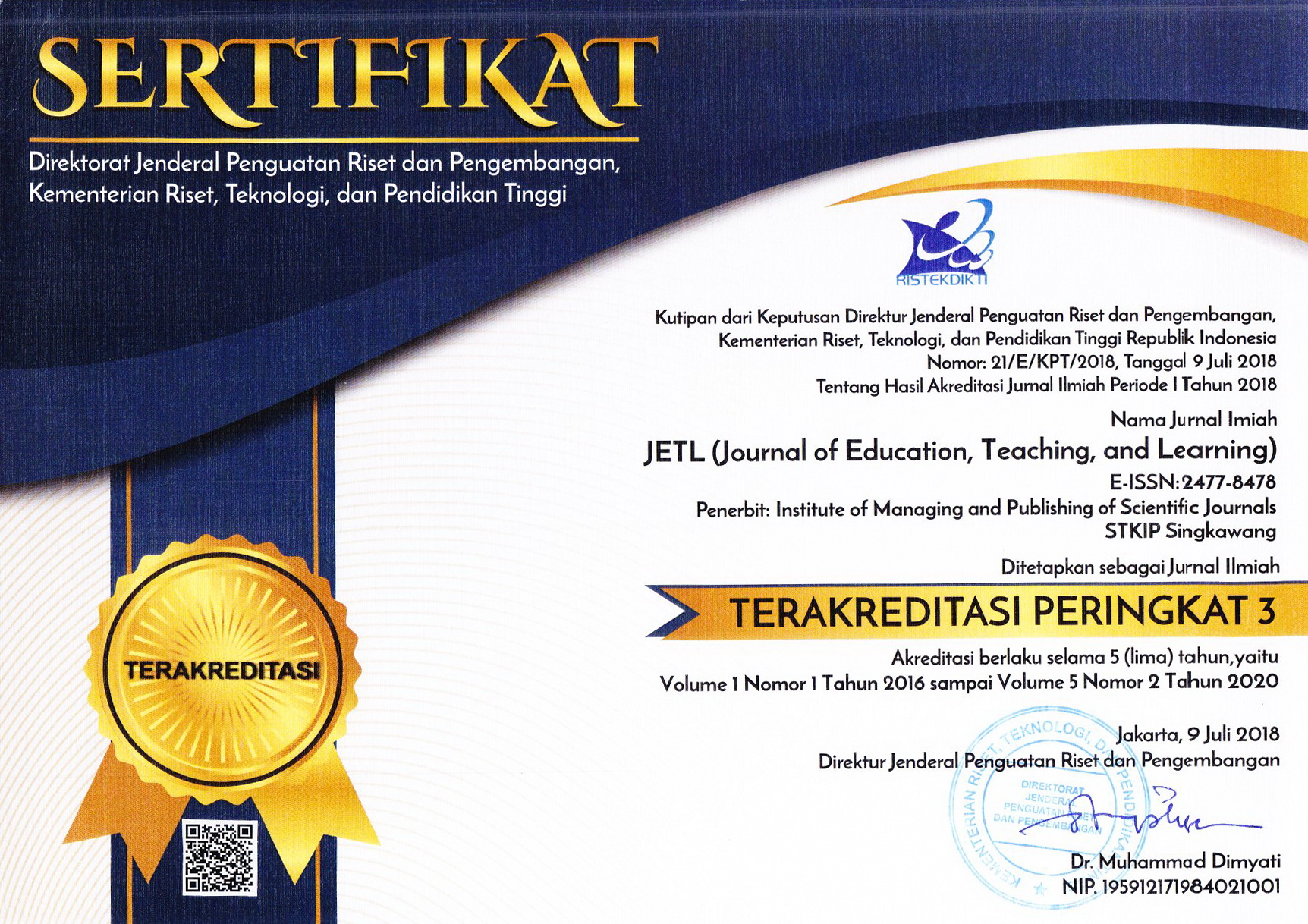


Vocational Education Revolution: Systematic Analysis of Augmented Reality Implementation in Technology and Vocational Learning
Abstract
Keywords
Full Text:
PDFReferences
AlGerafi, M. A. M., Zhou, Y., Oubibi, M., & Wijaya, T. T. (2023). Unlocking the Potential: A Comprehensive Evaluation of Augmented Reality and Virtual Reality in Education. Electronics, 12(18), Article 18. https://doi.org/10.3390/electronics12183953
Ariansyah, D., Pardamean, B., Barbaro, E., & Erkoyuncu, J. A. (2024). Augmented reality training for improved learnability. CIRP Journal of Manufacturing Science and Technology, 48(November 2023), 19–27. https://doi.org/10.1016/j.cirpj.2023.11.003
Asar, S., Jalalpour, S., Ayoubi, F., Rahmani, M. R., & Rezaeian, M. (2016). PRISMA; Preferred Reporting Items for Systematic Reviews and Meta-Analyses. Journal of Rafsanjan University of Medical Sciences, 15(1), 68–80. http://journal.rums.ac.ir/article-1-3021-en.html
Awadallah, O., Grolinger, K., & Sadhu, A. (2024). Remote collaborative framework for real-time structural condition assessment using Augmented Reality. Advanced Engineering Informatics, 62(PA), 102652–102652. https://doi.org/10.1016/j.aei.2024.102652
Bellalouna, F. (2021). The Augmented Reality Technology as Enabler for the Digitization of Industrial Business Processes: Case Studies. Procedia CIRP, 98(March), 400–405. https://doi.org/10.1016/j.procir.2021.01.124
Chan, V. S., Haron, H. N. H., Isham, M. I. B. M., & Mohamed, F. B. (2022). VR and AR virtual welding for psychomotor skills: A systematic review. Multimedia Tools and Applications, 81(9), 12459–12493. https://doi.org/10.1007/s11042-022-12293-5
Chiang, F.-K., Shang, X., & Qiao, L. (2022). Augmented reality in vocational training: A systematic review of research and applications. Computers in Human Behavior, 129, 107125. https://doi.org/10.1016/j.chb.2021.107125
Devagiri, J. S., Paheding, S., Niyaz, Q., Yang, X., & Smith, S. (2022). Augmented Reality and Artificial Intelligence in industry: Trends, tools, and future challenges. Expert Systems with Applications, 207, 118002. https://doi.org/10.1016/j.eswa.2022.118002
Iqbal, M. Z., Mangina, E., & Campbell, A. G. (2022). Current Challenges and Future Research Directions in Augmented Reality for Education. Multimodal Technologies and Interaction, 6(9), Article 9. https://doi.org/10.3390/mti6090075
Kouli, O., Murray, V., Bhatia, S., Cambridge, W. A., Kawka, M., Shafi, S., Knight, S. R., Kamarajah, S. K., McLean, K. A., Glasbey, J. C., Khaw, R. A., Ahmed, W., Akhbari, M., Baker, D., Borakati, A., Mills, E., Thavayogan, R., Yasin, I., Raubenheimer, K., … Wischhusen, S. (2022). Evaluation of prognostic risk models for postoperative pulmonary complications in adult patients undergoing major abdominal surgery: A systematic review and international external validation cohort study. The Lancet Digital Health, 4(7), e520–e531. https://doi.org/10.1016/S2589-7500(22)00069-3
Liono, R. A., Amanda, N., Pratiwi, A., & Gunawan, A. A. S. (2021). A Systematic Literature Review: Learning with Visual by The Help of Augmented Reality Helps Students Learn Better. Procedia Computer Science, 179, 144–152. https://doi.org/10.1016/j.procs.2020.12.019
Lotsaris, K., Fousekis, N., Koukas, S., Aivaliotis, S., Kousi, N., Michalos, G., & Makris, S. (2020). Augmented Reality (AR) based framework for supporting human workers in flexible manufacturing. Procedia CIRP, 96(March), 301–306. https://doi.org/10.1016/j.procir.2021.01.091
Martins, B. R., Jorge ,Joaquim Armando, & and Zorzal, E. R. (2023). Towards augmented reality for corporate training. Interactive Learning Environments, 31(4), 2305–2323. https://doi.org/10.1080/10494820.2021.1879872
Miltiadis, I., Skarlis, A., & Burko, P. (2025). The Role of Virtual Reality in Personalized Medicine: Advancing Prediction, Prevention, and Participation. Journal of Medical Systems, 49(1), 56. https://doi.org/10.1007/s10916-025-02191-2
Moencks, M., Roth, E., Bohné, T., & Kristensson, P. O. (2022). Augmented Workforce: Contextual, cross-hierarchical enquiries on human-technology integration in industry. Computers & Industrial Engineering, 165, 107822. https://doi.org/10.1016/j.cie.2021.107822
Mystakidis, S., Christopoulos, A., & Pellas, N. (2022). A systematic mapping review of augmented reality applications to support STEM learning in higher education. Education and Information Technologies, 27(2), 1883–1927. https://doi.org/10.1007/s10639-021-10682-1
Oliveira, J. L. C. de, Magalhães, A. M. M. de, Matsuda, L. M., Santos, J. L. G. dos, Souto, R. Q., Riboldi, C. de O., & Ross, R. (2021). Mixed Methods Appraisal Tool: Strengthening the Methodological Rigor of Mixed Methods Research Studies in Nursing. Texto & Contexto - Enfermagem, 30, e20200603. https://doi.org/10.1590/1980-265X-TCE-2020-0603
Park, S., & Stangl, B. (2020). Augmented reality experiences and sensation seeking. Tourism Management, 77, 104023. https://doi.org/10.1016/j.tourman.2019.104023
Radianti, J., Majchrzak, T. A., Fromm, J., & Wohlgenannt, I. (2020). A systematic review of immersive virtual reality applications for higher education: Design elements, lessons learned, and research agenda. Computers and Education, 147(July 2019), 103778–103778. https://doi.org/10.1016/j.compedu.2019.103778
Russo, M. (2021). AR in the Architecture Domain: State of the Art. Applied Sciences, 11(15), Article 15. https://doi.org/10.3390/app11156800
Shen, J., Yin, M., Wang, W., & Hua, M. (2024). Dwells in museum: The restorative potential of augmented reality. Telematics and Informatics Reports, 14(April), 100136–100136. https://doi.org/10.1016/j.teler.2024.100136
Shen, S., Xu, K., Sotiriadis, M., & Wang, Y. (2022). Exploring the factors influencing the adoption and usage of Augmented Reality and Virtual Reality applications in tourism education within the context of COVID-19 pandemic. Journal of Hospitality, Leisure, Sport and Tourism Education, 30(October 2021), 100373–100373. https://doi.org/10.1016/j.jhlste.2022.100373
Utami, L. P. R. A., Suwastini, N. K. A., Dantes, G. R., Suprihatin, C. T., & Adnyani, K. E. K. (2021). Virtual Reality For Supporting Authentic Learning In 21st Century Language Classroom. Jurnal Pendidikan Teknologi Dan Kejuruan, 18(1), 132–141. https://doi.org/10.23887/jptk-undiksha.v18i1.32376
Wagino, W., Maksum, H., Purwanto, W., Krismadinata, K., Suhendar, S., & Koto, R. D. (2023). Exploring the Full Potential of Collaborative Learning and E-Learning Environments in Universities: A Systematic Review. TEM Journal, 1772–1785. https://doi.org/10.18421/TEM123-60
Wu, S., Chen, H., Hou, L., Zhang, G. (Kevin), & Li, C. Q. (2024). Using Eye-Tracking to Measure Worker Situation Awareness in Augmented Reality. Automation in Construction, 165(November 2023), 105582–105582. https://doi.org/10.1016/j.autcon.2024.105582
Yudiernawati, A., Wahyuni, T. D., & Suryani, P. (2025). Learning innovation using augmented reality for interactive learning experiences. Jurnal Konseling Dan Pendidikan, 13(1), Article 1. https://doi.org/10.29210/1142300
DOI: http://dx.doi.org/10.26737/jetl.v10i2.7259
Refbacks
- There are currently no refbacks.


This work is licensed under a Creative Commons Attribution-NonCommercial 4.0 International License.
Published by:
Institute of Managing and Publishing of Scientific Journals STKIP Singkawang
Sekolah Tinggi Keguruan dan Ilmu Pendidikan (STKIP) Singkawang
Address : STKIP Singkawang, Jalan STKIP - Kelurahan Naram Singkawang, Kalimantan Barat, INDONESIA, 79251
No. Telp. : +62562 420 0344
No. Fax. : +62562 420 0584
JETL (Journal of Education, Teaching, and Learning)
e-ISSN : 2477-8478
p-ISSN : 2477-5924

Editor in Chief Contact: [email protected] / Wa: +6285245101122
Publisher Contact: [email protected] / Wa: +6281217024040/+6285750845033
Management Tools



JETL Indexed by: