Email this article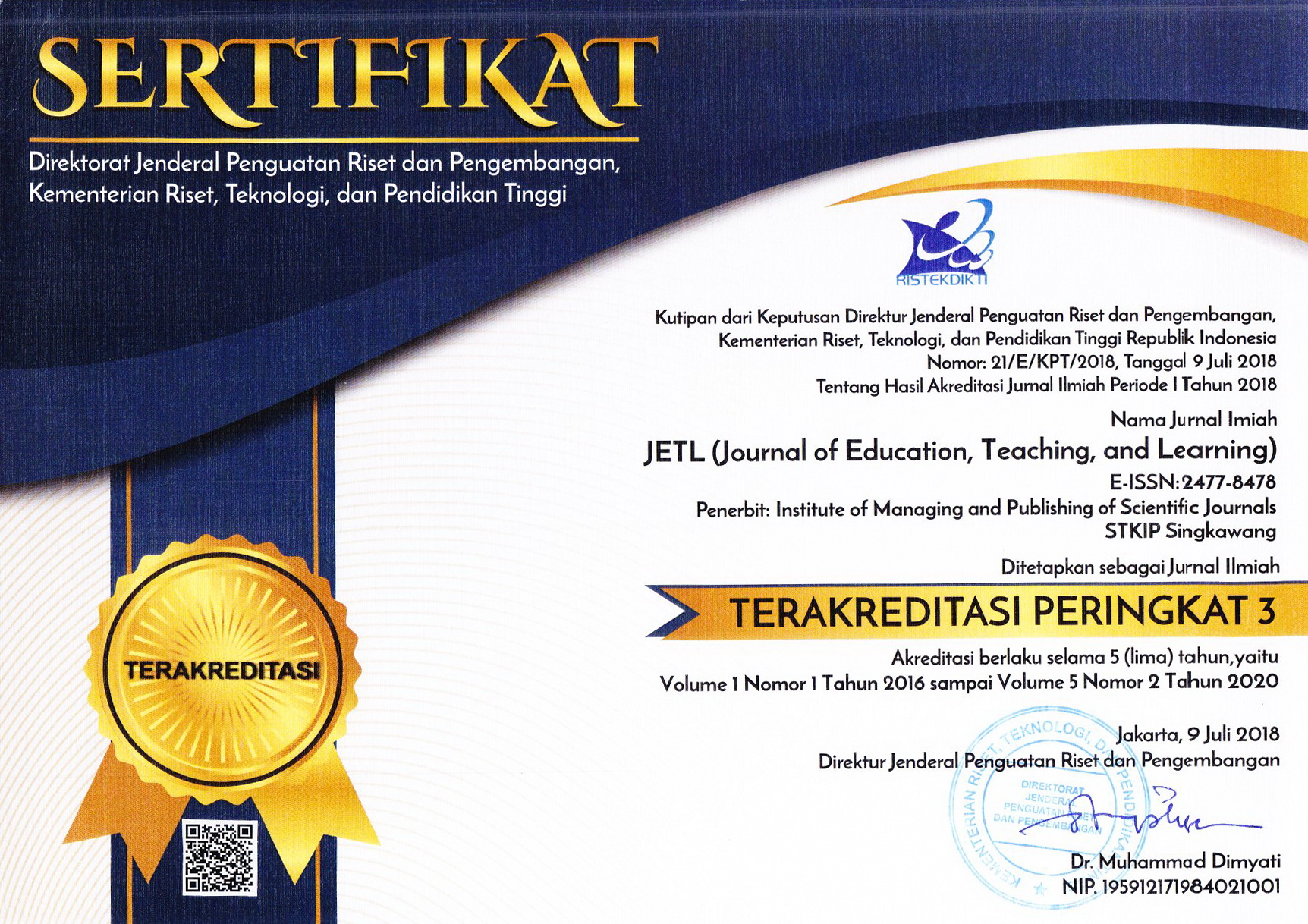


Student’s Covariational Reasoning in Solving Covariational Problems of Dynamic Events
Abstract
Keywords
Full Text:
PDFReferences
Carlson, M. P. (1998). A cross-sectional investigation of the development of the function concept. CBMS Issues in Mathematics Education, 7, 114–162. https://doi.org/10.1090/cbmath/007/04
Carlson, M. P., Jacobs, S., Coe, E., Larsen, S., & Hsu, E. (2002). Applying Covariational Reasoning While Modeling Dynamic Events: A Framework and a Study. Journal for Research in Mathematics Education, 33(5), 352. https://doi.org/10.2307/4149958
Carlson, M. P., Madison, B., & West, R. D. (2015). A Study of Students’ Readiness to Learn Calculus. International Journal of Research in Undergraduate Mathematics Education, 1(2), 209–233. https://doi.org/10.1007/s40753-015-0013-y
Creswell, J. W. (2014). Research Design: Qualitative, Quantitative, and Mixed Methods Approaches (Fourth Edi; V. Knight, J. Young, K. Koscielak, B. Bauhaus, & M. Markanich, eds.). Washington, DC: SAGE Publication.
Dogbey, J. (2016). Using Variables in School Mathematics: Do School Mathematics Curricula Provide Support for Teachers? International Journal of Science and Mathematics Education, 14(6), 1175–1196. https://doi.org/10.1007/s10763-015-9643-4
Ellis, A. B., Ozgur, Z., Kulow, T., Dogan, M. F., & Amidon, J. (2016). An Exponential Growth Learning Trajectory: Students’ Emerging Understanding of Exponential Growth Through Covariation. Mathematical Thinking and Learning, 18(3), 151–181. https://doi.org/10.1080/10986065.2016.1183090
Ellis, A. B., Özgür, Z., Kulow, T., Williams, C. C., & Amidon, J. (2015). Quantifying exponential growth: Three conceptual shifts in coordinating multiplicative and additive growth. Journal of Mathematical Behavior, 39, 135–155. https://doi.org/10.1016/j.jmathb.2015.06.004
Fennel, F., & Rowan, T. (2001). Representation: An important process for teaching and learning mathematics. Teaching Children Mathematics, 7(5), 288–292.
Ferrari-Escolá, M., Martínez-Sierra, G., & Méndez-Guevara, M. E. M. (2016). “Multiply by adding”: Development of logarithmic-exponential covariational reasoning in high school students. Journal of Mathematical Behavior, 42, 92–108. https://doi.org/10.1016/j.jmathb.2016.03.003
Gyamfi, K. ., & Bosse, M. . (2013). Processes and Reasoning in Representations of Linear Functions. International Journal of Science and Mathematics Education, 12(1), 167–192. https://doi.org/10.1007/s10763-013-9416-x
Herbert, S., & Pierce, R. (2012). Revealing educationally critical aspects of rate. Educational Studies in Mathematics, 81(1), 85–101. https://doi.org/10.1007/s10649-011-9368-4
Johnson, H. L., McClintock, E., & Hornbein, P. (2017). Ferris wheels and filling bottles: a case of a student’s transfer of covariational reasoning across tasks with different backgrounds and features. ZDM - Mathematics Education, 49(6), 851–864. https://doi.org/10.1007/s11858-017-0866-4
Lobato, J., & Siebert, D. (2002). Quantitative reasoning in a reconceived view of transfer. Journal of Mathematical Behavior, 21(1), 87–116. https://doi.org/10.1016/S0732-3123(02)00105-0
Moore, K. C. (2014). Quantitative Reasoning and the Sine Function: The Case of Zac. Journal for Research in Mathematics Education, 45(1), 102. https://doi.org/10.5951/jresematheduc.45.1.0102
Moore, K. C., & Carlson, M. P. (2012). Students’ images of problem contexts when solving applied problems. Journal of Mathematical Behavior, 31(1), 48–59. https://doi.org/10.1016/j.jmathb.2011.09.001
Moore, K. C., Silverman, J., II, D. R. L., Musgrave, S., Paoletti, T., & LaForest, K. R. (2013). Pre-service teachers ’ meanings and non-canonical graphs. In M. Martines & A. Castro Superfine (Eds.), Proceedings of the 35th annual meeting of the North American Chapter of the International Group for the Psychology of Mathematics Education (pp. 441–448). Retrieved from http://pmena.org/2013/proceedings.html
Moore, K. C., Stevens, I. E., Paoletti, T., Hobson, N. L. F., & Liang, B. (2019). Pre-service teacher’s figurative and operative graphing actions. The Journal of Mathematical Behavior. https://doi.org/10.1016/j.jmathb.2019.01.008
Paoletti, T., & Moore, K. C. (2017). The parametric nature of two students’ covariational reasoning. Journal of Mathematical Behavior, 48(April), 137–151. https://doi.org/10.1016/j.jmathb.2017.08.003
Polya, G. (1973). How to Solve it: A New Aspect of Mathematical Method (2nd ed.). Princeton, New Jersey: Princeton University Press.
Saldanha, L. A., & Thompson, P. W. (1998). Re-thinking covariation from a quantitative perspective: simultaneous continuous variation. In S. B. Berensah & W. N. Coulombe (Eds.), Proceedings of the Annual Meeting of the Psychology of Mathematics Education - North America. Raleigh, NC: North Carolina State University.
Sandie, Purwanto, Subanji, & Hidayanto, E. (2019a). Student Difficulties when Constructing a Hidden Bridge to Solve Dynamic Event Problems. In Habiddin, S. Majid, S. Ibnu, N. Farida, & I. W. Dasna (Eds.), The 3rd International Conference on Mathematics and Sciences Education (ICoMSE) 2019 (pp. 0600261–0600265). Malang: AIP Publishing.
Sandie, S., Purwanto, P., Subanji, S., & Hidayanto, E. (2019b). Student difficulties in solving covariational problems. International Journal of Humanities and Innovation (IJHI), 2(2), 25–30. https://doi.org/10.33750/ijhi.v2i2.38
Subanji. (2007). Proses Berpikir Penalaran Kovariasional Pseudo dalam Mengonstruksi Grafik Fungsi Kejadian Dinamik Berkebalikan. Surabaya.
Subanji. (2011). Teori Berpikir Pseudo Penalaran Kovariasional. Malang, Indonesia: UM Press.
Thompson, P. W. (1994). Students, functions, and the undergraduate curriculum. In E. Dubinsky, A. H. Schoenfeld, & J. J. Kaput (Eds.), Research in Collegiate Mathematics Education, 4, 21–44. https://doi.org/10.2307/2687592
Thompson, P. W., & Carlson, M. P. (2017). Variation, Covariation and Functions: Foundation ways of thinking mathematically. Compendium for Research in Mathematics Education, (January), 421–456.
Thompson, P. W., Hatfield, N. J., Yoon, H., Joshua, S., & Byerley, C. (2017). Covariational reasoning among U.S. and South Korean secondary mathematics teachers. Journal of Mathematical Behavior, 48(August), 95–111. https://doi.org/10.1016/j.jmathb.2017.08.001
Weber, E., & Thompson, P. W. (2014). Students’ images of two-variable functions and their graphs. Educational Studies in Mathematics, 87(1), 67–85. https://doi.org/10.1007/s10649-014-9548-0
Wilkie, K. J. (2019). Investigating Students’ Attention to Covariation Features of their Constructed Graphs in a Figural Pattern Generalisation Context. International Journal of Science and Mathematics Education, 47–49. https://doi.org/10.1007/s10763-019-09955-6
Yemen-Karpuzcu, S., Ulusoy, F., & Işıksal-Bostan, M. (2015). Prospective Middle School Mathematics Teachers’ Covariational Reasoning for Interpreting Dynamic Events During Peer Interactions. International Journal of Science and Mathematics Education, 15(1), 89–108. https://doi.org/10.1007/s10763-015-9668-8
DOI: http://dx.doi.org/10.26737/jetl.v5i2.2092
Refbacks
- There are currently no refbacks.


This work is licensed under a Creative Commons Attribution-NonCommercial 4.0 International License.
Published by:
Institute of Managing and Publishing of Scientific Journals STKIP Singkawang
Sekolah Tinggi Keguruan dan Ilmu Pendidikan (STKIP) Singkawang
Address : STKIP Singkawang, Jalan STKIP - Kelurahan Naram Singkawang, Kalimantan Barat, INDONESIA, 79251
No. Telp. : +62562 420 0344
No. Fax. : +62562 420 0584
JETL (Journal of Education, Teaching, and Learning)
e-ISSN : 2477-8478
p-ISSN : 2477-5924

Editor in Chief Contact: [email protected] / Wa: +6285245101122
Publisher Contact: [email protected] / Wa: +6281217024040/+6285750845033
Management Tools



JETL Indexed by: