


 Email this article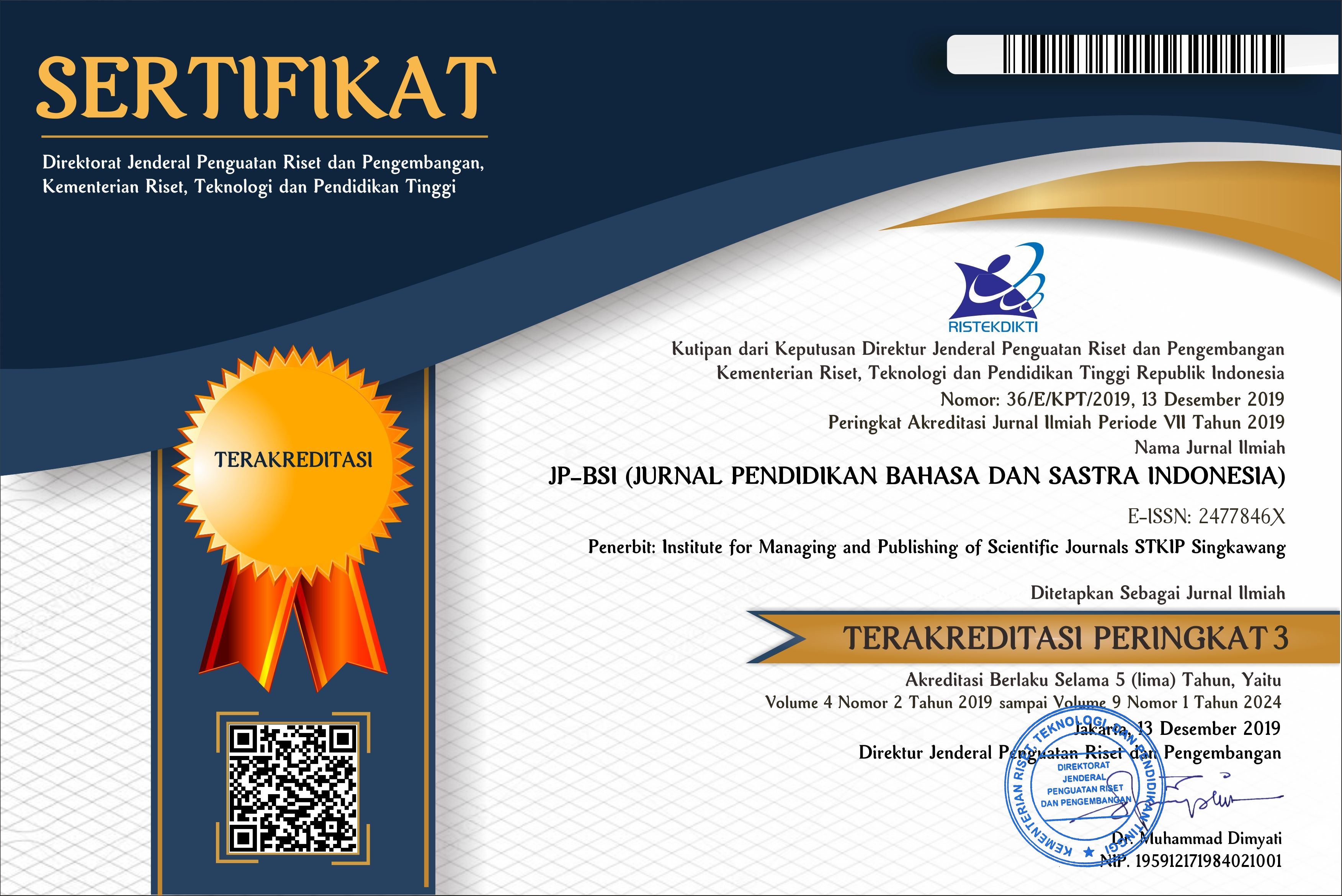


Pergeseran Generasi dan Tensi Linguistik: Penggunaan Bahasa Gaul yang Kontroversial dalam Komunitas Pondok Pesantren Heterogen
Abstract
This research analyzes Generational Shifts and Linguistic Tensions: Controversial Use of Slang in Heterogeneous Islamic Boarding School Communities. The aim of this research is to explore the dynamics of the use of slang among students in heterogeneous Islamic boarding schools, with a focus on how this language shapes their daily communication, analyzing the sociolinguistic impact of slang on traditional linguistic norms in the Islamic boarding school environment. The method used in this research is a qualitative method that directly observes the phenomenon of language shift in Islamic boarding schools. Based on the research results, it was found that there was a shift in language which showed a shift in the vocabulary commonly used in everyday conversation, the use of this vocabulary reflects a style of speech that is considered relaxed in interactions between peers, for example the words "santuy", "sabi", "kuy" etc. The implications of this research can be used as a benchmark for intergenerational language shifts in Islamic boarding schools and reveal how modern language trends interact with established cultural and religious expectations.
Full Text:
PDFReferences
Achmadin, B. Z., Kawakip, A. N., Nafis, M. M., Barizi, A., Asrori, M., & Amrullah, A. M. K. (2024). The Future of Pesantren: Reconciling Tradition with Global Educational Trends. Jurnal Pendidikan Agama Islam (Journal of Islamic Education Studies), 12(2), 197–222.
Anggaira, A. S., Sari, Y. A., Putra, A. P., Pradana, S. A., & Anastasya, M. (2024). Cross Culture Understanding World Wide Islamic Culture. Insight Mediatama.
Ani, S., Rahman, I., & Khoiriyah, F. (2024). TREN BAHASA DAN IDENTITAS KOLEKTIF SANTRI DALAM PENGGUNAAN BAHASA GAUL: STUDI BAHASA “MENYALA ABANGKUH.” PENTAS: Jurnal Ilmiah Pendidikan Bahasa Dan Sastra Indonesia, 10(1), 14–21.
Aririguzoh, S. (2022). Communication competencies, culture and SDGs: effective processes to cross-cultural communication. Humanities and Social Sciences Communications, 9(1), 1–11.
Arshad, A., & Arslan, M. F. (2024). LANGUAGE AND GENDER: INVESTIGATING AGE-BASED TOPIC VARIATIONS AMONG FEMALES. Journal of Applied Linguistics and TESOL (JALT), 7(4), 1275–1283.
Bonnefon, J.-F., Rahwan, I., & Shariff, A. (2024). The moral psychology of Artificial Intelligence. Annual Review of Psychology, 75(1), 653–675.
Chuanchen, C., & Zaini, A. W. (2023). Cultivating Cultural Synergy: Unifying Boarding Schools, Local Wisdom, and Authentic Islamic Values for the Enhancement of Islamic Identity. Managere: Indonesian Journal of Educational Management, 5(2), 187–197.
Dahlan, Z., Tanjung, M., Asari, H., & Wibowo, B. S. (2025). CELEBRITY ULAMA’: opportunities for the commodification of religion and the values of Islamic education Das’ ad Latif. Cogent Arts & Humanities, 12(1), 2492427.
Darmini, A. M. M. (2021). Internet and the public sphere in the Indonesian Islamic boarding schools (Pondok Pesantren): power, piety, and the popular. University of Warwick.
Hadi Mogavi, R., Son, J., Yang, S., Wang, D. M., Choong, L., Alhilal, A., Zhou, P. Y., Hui, P., & Nacke, L. E. (2024). The Jade Gateway to Exergaming: How Socio-Cultural Factors Shape Exergaming Among East Asian Older Adults. Proceedings of the ACM on Human-Computer Interaction, 8(CHI PLAY), 1–34.
Halim, N. M., & Dahniar, D. (2023). The Investigation of Slang Used by Undergraduate Students on Daily Basis Interaction. ASHLITION: Ash-Shahabah English Literature, Linguistics, & Education, 1(1), 10–17.
Hijrah, N., Rialni, D. A. P., Maysarah, M., Sari, Y., & Adisaputera, A. (2024). Pergeseran Makna dan Ekspresi Identitas Penggunaan Bahasa Gaul di Media Sosial. Narasi: Jurnal Kajian Bahasa, Sastra Indonesia, Dan Pengajarannya, 2(1), 93–100.
Hill, R. (2022). Generational harmony saves the world: how the power of generation theory, gen z youth, and activism can mitigate the climate crisis.
Ihsan, M. N., Ahmad, N., Hasanah, A., & Suhartini, A. (2021). Islamic boarding school culture climate in forming the religious attitude of islamic students in modern and agrobusiness islamic boarding schools. Nazhruna: Jurnal Pendidikan Islam, 4(2), 362–382.
Islamic, G., Ishaq, M., & Dayati, U. (2024). Character education through philosophical values in traditional Islamic boarding schools. Kasetsart Journal of Social Sciences, 45(1), 31–42.
Jaelani, J., & Ziadah, Z. (2024). Language Use and Linguistic Performance in Peer Counselling within a Religious Tertiary Education Context. In Psycholinguistics-New Advances and Real-World Applications. IntechOpen.
Karpava, S. (2025). Afterword: Multilingualism, Inclusive Education, and Social Justice. In Inclusive Education, Social Justice, and Multilingualism (pp. 249–291). Springer.
Mahesti, A., & Jaya, A. (2024). DINAMIKA PENGGUNAAN BAHASA INDONESIA DAN BAHASA GAUL DI KALANGAN GENERASI MUDA. Parataksis: Jurnal Bahasa, Sastra, Dan Pembelajaran Bahasa Indonesia, 7(2).
Mahmud, M., Hanif, M., & Hidayatullah, M. F. (2022). Character Education Strategy at Boarding School. Nazhruna: Jurnal Pendidikan Islam, 5(1), 51–63.
Manongcarang, S. M. D., & Guimba, S. D. (2024). Intergenerational Challenges and How They Manifest in the Public Workforce: A Basis for Designing Effective Performance Management Strategies. Workforce, 7(25).
Manurung, J., Napitupulu, M. H., & Simangunsong, H. (2022). Exploring the Impact of Slang Usage Among Students on WhatsApp: A Dig-ital Linguistic Analysis. Jurnal Ilmu Pendidikan Dan Humaniora, 11(2), 153–169.
Mau, F. A. (2024). Integrating Character Education in Al-Syifa Islamic Boarding Schools: A Case Study Approach. Edu Spectrum: Journal of Multidimensional Education, 1(1), 1–14.
Maulidiya, R., Wijaya, S. E., Adha, T. P., & Pandin, M. G. R. (2021). Language Development of slang in the Younger Generation in the Digital Era.
Monti, N. (2025). Automatic poetics. A study of the history and semiotic conditions of artificial linguistic creativity.
Mustofa, A., & Hakim, A. R. (2024). SUFISM EDUCATION IN THE FORMATION OF MODERATE ISLAMIC ATTITUDES OF YOUTH IN URBAN MUSLIMS. Akademika: Jurnal Pemikiran Islam, 29(1), 117–130.
Puspita, V. G., & Ardianto, A. (2024). Code-Switching and Slang: An Analysis of Language Dynamics in the Everyday Lives of Generation Z. Linguistics Initiative, 4(1), 76–87.
Rohinah, R. (2022). Preferences Activism of Islamic Spiritual (Rohis) in Schools and Madrasas in Yogyakarta: From Narrative Islamism to Popular Culture. Jurnal Pendidikan Islam, 11(1), 1–10.
Salvador, R. T., Parrar, D. M., Yapiso, L., & Cuadra, J. S. (2024). Sociolinguistic Perspectives on Slang: Analyzing Attitudes and Implications in Oral Communication within Higher Education. Sociolinguistic Perspectives on Slang: Analyzing Attitudes and Implications in Oral Communication within Higher Education (August 21, 2024).
Uriarte, J. R., & Sperlich, S. (2021). A behavioural model of minority language shift: Theory and empirical evidence. PloS One, 16(6), e0252453.
Webre, A.-C., & Freeman, D. (2025). Researching English Teacher Development and Classroom Instruction in Indonesian Madrasahs and Pesantren.
Wibisono, B., Haryono, A., & Fadlil, F. M. (2022). The use of honorifics in Islamic boarding schools as a form of maintaining a culture of courtesy. International Journal of Social Sciences and Humanities Invention, 9(04), 6952–6967.
DOI: http://dx.doi.org/10.26737/jp-bsi.v10i1.6766
Refbacks
- There are currently no refbacks.
Diterbitkan oleh:
Institut Pengelolaan dan Penerbitan Jurnal Ilmiah STKIP Singkawang
e-ISSN: 2477-846X
p-ISSN: 2477-5932
Sekolah Tinggi Keguruan dan Ilmu Pendidikan ( STKIP) Singkawang
Alamat : STKIP Singkawang, Jalan STKIP - Kelurahan Naram Singkawang, Kalimantan Barat, INDONESIA, 79251
No. Telp. : +62562 420 0344
No. Faks. : +62562 420 0342

Editor in Chief: [email protected] / Wa: +6285747889416
Coordinator: [email protected] / [email protected] / Wa: +6282142072788
Alat Manajemen



JP-BSI Diindeks oleh:










JP-BSI (Jurnal Pendidikan Bahasa dan Sastra Indonesia) dilisensikan di bawah Lisensi Internasional Creative Commons Atribusi-NonKomersial 4.0 .